

- Español
- Hindi
- Marathi
- Kannada
- 中文 (简体)
- Français
Introduction
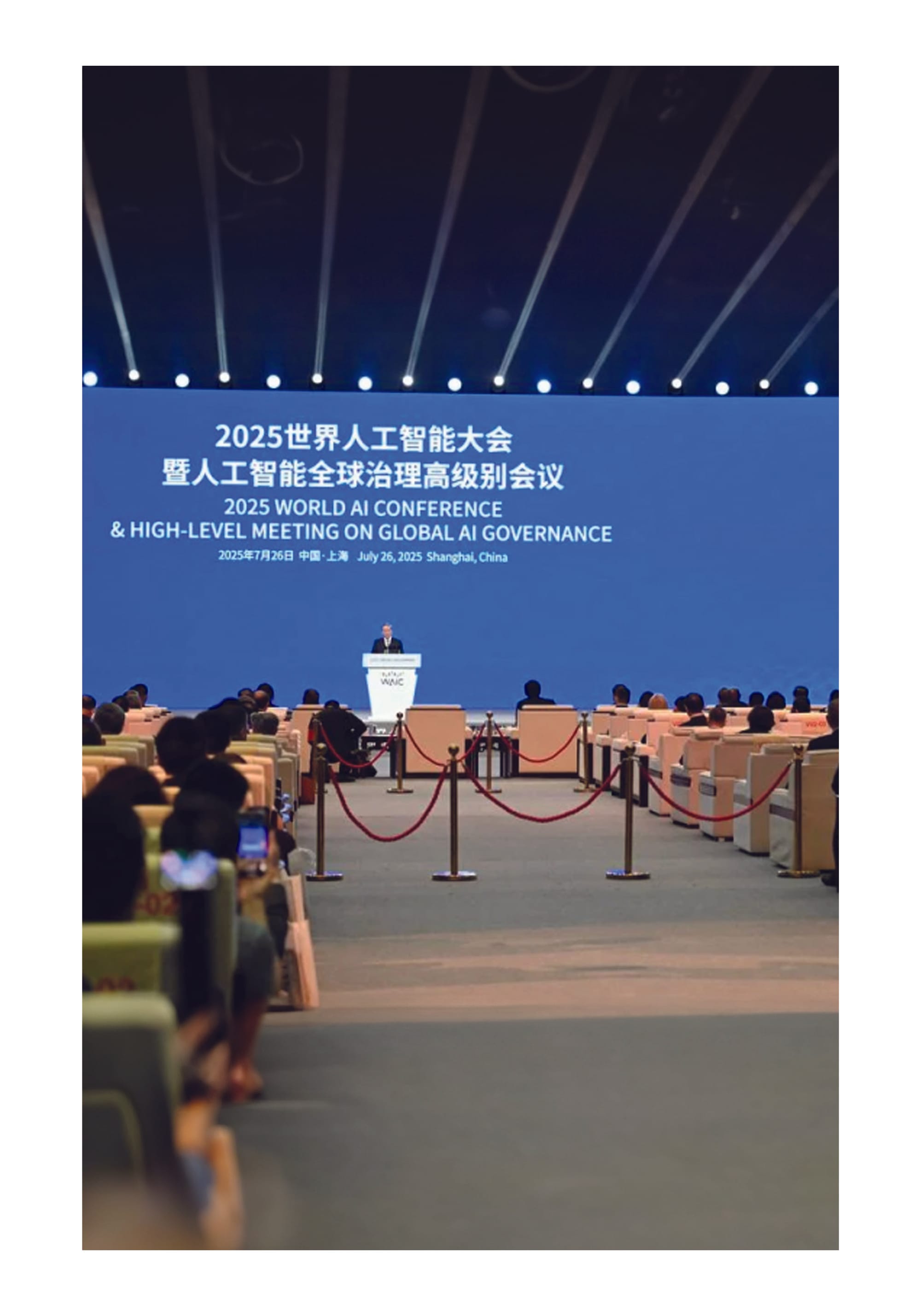
At the end of July 2025, Shanghai hosted the World Artificial Intelligence Conference, an event described by the Singapore-based think tank, Artificial Intelligence International Institute, as “one of the most influential gatherings within the global tech, science, and industry ecosystem”. On the first day of the conference, the Chinese government released the Action Plan for the Global Artificial Intelligence Governance, signalling a concerted effort to shape the international regulation on Artificial Intelligence. The plan envisions a coalition led by China, Singapore, the United Kingdom and the European Union to establish shared norms and regulatory frameworks, whereas the Unites States has pursued a more isolationist and lightly regulated approach, privileging national competitiveness over global coordination.
This initiative is significant because it reflects China’s ambition to assume a central role in establishing norms, standards, and ethical frameworks for AI. At the same time, raises critical questions regarding China’s objectives, what is the main how will it balance domestic priorities with international collaboration? What objectives does China seek to achieve in the domain of artificial intelligence? What is its technological approach?
The emerging technologies have become a fundamental feature of the contemporary international relations because of its ubiquity in the human activities. The profound effect have permeated in many fields and disciplines in vast scale and deep scope. For that reason, technology has become a global phenomenon. Until recently, technology has not been studied systematically in international relations or outside of the technical considerations. Nevertheless, in recent years, technology topics are beginning to have great value for international politics.
Primarily, the technologies that promote interconnectivity are prominent among the state concerns and the deployment of strategies to control, regulate and influence them. Many governments have put high-technology as a priority for their development, trying to ensure and safeguarding the integrity of these infrastructures as their main approach to the digital realm. Essentially in the case of Chinese government, these tasks are carried out through the mobilization of considerable amount of material and immaterial resources. The People’s Republic of China have underpinned areas like cybersecurity, autonomous technology development and the establishment of technological standards as a strategic priorities.
The cyber domain has become a zone of geopolitical competition of states. Given their importance for politics, international security, and economic growth, the digital technologies and critical infrastructures have become key factors in the relationship between powers. Specifically, this translates into agendas, ideologies, capabilities development that take place in this new geopolitical space. In the case of China, this has become evident with an active role in global technology governance. The Chinese government considers that some aspects of the regulation technology are fundamental both domestic and external strategic aspiration.
The Chinese government has decided to fully engage with recent technological transformations to accelerate its development through a series of increasingly coherent and comprehensive initiatives. This has led the government of the People’s Republic of China to seek to create the conditions for technology governance, primarily through data processing centres, the deployment of fibber optic cables, the building of AI models, and the research in quantum computing. The main objective is to drive technological innovation as a priority for China’s domestic and external development. I highlight that, first, China’s technological development primarily responds the need to bolster domestic development and, consequently, also serves as an instrument for international positioning and influence. However, what are the main characteristics of Chinese technological approach? In what form is related with an evolution in its foreign policy?
Without intending to offer an exhaustive analysis, this text aims to establish certain theoretical and methodological foundations for the study of a complex phenomenon in international relations, one that is expected to persist and emerge as a central issue in the new world order: namely the pervasive role of technology across virtually all domains of human activity and the ways in which social actors respond to the opportunities and challenges it engenders.
The China’s Approach to Technology Governance
Several of the current technologies are part and product of the globalisation processes, and therefore represent a crossroads in global governance frameworks. Since Deng Xiaoping reforms, China has taken advantage of the global market to develop its economic leverage and its international projection. In this way, China have sought to play a fundamental role in shaping, building, and consolidating technological governance processes. Moreover, this represents an expression of the evolution of its foreign policy approach. We can say that the Chinese foreign approach transitioned from an alignment to the socialist bloc, to isolation to compenetrating to the global structures. In this tenor, China have developed external policies that seek to be more cooperative and accommodate to the global order.
There is an intense and ongoing debate regarding China’s role in shaping global governance, particularly in the realms of trade, international standards, and technology. Scholars and policymakers question the extent to which China seeks to influence existing international institutions versus creating parallel frameworks that reflect its strategic interests and development model. Some scholars argue that the domestic challenges could be a load to the aspirations of Chinese government to become a global player. This position highlights that China must focus on avoid a major confrontation with other powers and concentrate on its domestic development. Some agree that China should take a more responsible role to the global issues. In this side, the argument indicates that the position and interest of China in any issue can be ignored. This debate is driven by the country’s growing economic, geopolitical, and technological power, which allows it to assert significant influence in multilateral forums, set regulatory norms, and promote initiatives -such as those related to digital governance and artificial intelligence governance- that may diverge from the other technological powers. Consequently, discussions about China’s participation in global governance raise critical questions about balance between cooperation and competition among major powers, the legitimacy of new rules, and the potential reshaping of the global order.
For that reason, the Chinese authorities have argued how China should increase its participation in the global governance but at the same time trying not to create antagonistic positions. China has adopted a comprehensive approach to technology governance. It is important to note that China’s advancement in high-technology has been shaped through a gradual and organic process, reflecting a strategy that balances state-led planning, innovation, and the building of technological ecosystems.
For the Chinese government, some technologies stand out for their potential and capacity to support different areas of human development such as artificial intelligence, robotics, 5G, telecommunications, aeronautical and aerospace technology and biotechnology. In this context, China’s commitment to technology has been operationalized through a range of strategic programs and initiatives aimed to foster technological innovation, achieving strategic autonomy in science and technology, and enhancing the capabilities of both public and private actors within technological ecosystems. In this regard, some initiatives have been released, including but not limited to the following: Made in China 2025, the New Generation Artificial Intelligence Development Plan, the Cybersecurity Law, the Data Security Law, the Personal Information Protection Law and the Code of Ethics for New Generation AI.
On one hand, the Made in China 2025 was an initiative to integrate intelligent processes into various manufacturing sectors. The project aimed to position China as a leading power in ten strategic sectors of advanced technology. For its part, the New Generation Artificial Intelligence Development Plan, have conducted a coordinated framework to address some of the challenges related with the emerging technologies. According to the Chinese authorities, the main goal is to establish China as the leader of Artificial Intelligence applications by 2030. On the other hand, the Data Security Law and, the Personal Information Protection Law were issued to enhance data security and to set strict rules over personal information. collection and use. Finally, the Code of Ethics for New Generation AI pretends to function as an ethical guide in the development of AI.
The primary objective of these legislative measures is to position China as a leading driver of technological innovation on the global stage. On one hand, certain regulations emphasize the necessity of deepening domestic reforms, enhancing the internal economic environment, and fostering conditions to industrial improvement. By strengthening domestic capacities, the Chinese government aims to build a robust economic position that can sustain the regime legitimacy. On the other hand, these policies serve as a strategic roadmap for China’s transformation into an important player within the global technology governance. Through coordinated policies, China seeks to shape international standards, norms, and governance mechanism in emerging technological fields such as artificial intelligence, biotechnology, and quantum computing.
However, there is disagreement for the core governance of some high-technologies. Disputes over digital governance increasingly represent one of the primary arenas of global competition the new spaces of competition in the twenty-first century. As technology becomes ever more central to economic, political, and military power, control over the rules, norms and regulatory frameworks has emerged as a strategic priority for major states. Currently, the state of global digital governance is fragmented and lacks coordination. Three main perspectives stand out for attempting to articulate and organize the global technological landscape.
First, the United States has historically adopted a multi-stakeholder approach to digital governance, emphasizing the involvement of a diverse array of actors, including government agencies, private companies, civil society organizations, and technical communities. This approach reflects a relatively flexible regulatory perspective. meanwhile, the approach of the European Union prioritize the protection of individual over the state interests. The main purpose of EU is to offer personal data protection above the interest of the state. Finally, China’s approach is largely state-centric, with digital governance policies designed to align data management with national strategic priorities. These differences illustrate the extent to which political and legal principles inform and shape models of digital governance, while simultaneously highlighting the inherent challenges and frictions encountered in efforts to formulate integral standards for data protection.
To the authorities in China it is essential to have an active participation in the global regulatory frameworks, to generate an strengthened articulation of the technological sector with national security, to contribute to the reduction of risks vectors for the damage of information, and to promote the concept of cyber-sovereignty as an organising principle of cyberspace. For the Chinese government, the issue of cybersecurity is closely tied to its governing practice. In other words, beyond the technical aspects of information protection, cybersecurity also plays a fundamental role in reducing points of vulnerability that may undermine social order and the legitimacy of the central government. On one hand, the Chinese government is promoting the free flow of data related to digital commerce, while, on the other hand, other types of digital information are demanding stricter data control. This clearly reflects the form of China’s proposed digital architecture, which aligns the Chinese government domestic and foreign strategic priorities.
With this in mind, the Chinese government asserts that cyberspace should not be an unregulated or anarchic environment. This stance has gradually led to an increase in the productions of norms to govern the cyber domain, resulting in an increasingly complex and intricate regulatory framework. As several scholars have observed, Chinese authorities have sought to play a more prominent role in several institutions responsible for the governance of global standards. This reflects a broader strategic intent to influence the normative architecture of cyberspace to align the global governance with national interests.
In this effort, technical standardisation has been a crucial component of global data governance. On this effort, the Chinese authorities have increase their engagement with different international organization, particularly with the International Organization for Standardisation. The People’s Republic of China has expressed its interest in being a central actor in shaping the norms, standards, and values of digital governance. On this basis, the China’s digital governance approach integrates elements of sovereignty, national security, development and privacy. To this end, the Chinese government has sought to outlines a framework of digital governance that addresses both domestic and external strategic considerations.
Likewise, the Chinese government has advanced initiatives such as the Global Data Security Initiative, which underscores the importance of safeguarding national sovereignty, data governance rights, and norms to rule the cyberspace. While, I do not deny the existence of strategic competition with other powers -particularly the US- in the technological sphere, I try to move beyond the Manichean narratives that portray a single side view of China’s technological strategies. Although the Chinese authorities consistently emphasize the pursuit of joint global solutions to the challenges affecting the digital sphere, regularly, their positions do not fully align with the perspectives of other powers, thereby giving rise to situations of competition and even conflict.
Final Remarks
It is worth to mention that a systemic level a complex and unprecedented dynamic has begun to emerge. In the global geostructure, the world is undergoing a hegemonic shift framed within an intense dynamics of strategic competition, in which the technological factors appears to be crucial and indispensable. While the United States has prioritized technological primacy, China has placed significant emphasis on coordinated global governance of technology. The Chinese government has tried to engage in technical discussion on AI security, the necessity for regulation on technology and oversight to mitigate risks information. This approach has combined national interests with collaborative efforts with other powers.
In that tenor, technological competition between China and the United States has emerged as one of the defining features of contemporary international relations, shaping both economic and geopolitical dynamics in the twenty-first century. At the same time, China-US technological competition is not confined only to the technological sphere, but represents a broader contest over the definition of values, normative principles, and institutional architecture of the emerging global order. However, without denying the reality, my argument is that such a perspective could obstruct the possibility and spaces of confluence and cooperation between China and the United States.
This implies that global technological cooperation yields significant benefits. collaborative initiatives enable the pooling of resources, expertise and knowledge thereby accelerating scientific and technological progress. It is also important to emphasize that most states around the world face comparable challenges in the digital sphere. Confronting shared issues such as cybersecurity threats, weaponization of artificial intelligence, data governance, and the ethical application of emerging technologies requires sustained cooperation, the formulation of common standards and the promotion of interoperability.
Several scholars have underscored the considerable influence that technological corporate actors exert over the regulatory frameworks shaping the digital sphere. Some scholar has even pointed out that their influence is so profound that it marks a “technopolar” moment in international relations, fundamentally altering the authority of the state. This dynamic raises critical questions about the accountability of such actors, the balance of power between states and private corporations, and the potential risks to both national sovereignty and global digital governance.
To this end, China’s intent to reshape the contours of global technological governance reflects a comprehensive approach that integrates political, economic, social and technical dimensions. This digital approach seeks to regulate both domestic and international digital governance, making the enhancement of technological capabilities a fundamental pillar of China’s governance strategy. In this sense, the technological domain is not only instrumental for strengthening global governance capacities but also for advancing national development and promoting the overall welfare of society.
Similarly, I have argued that technical and scientific advancement constitutes a crucial element in the construction of a new global order for the Chinese government. The People’s Republic of China deliberately seeks to endow the digital environment with new characteristics and capacities, articulated through a range of far-reaching initiatives. The interplay between domestic and global imperatives reflects a deliberative approach in which technological development functions simultaneously as a tool for domestic reforms and as a an instrument of global positioning.