


- Español
- Hindi
- Marathi
- Kannada
- 中文 (简体)
- Français
Editors Note
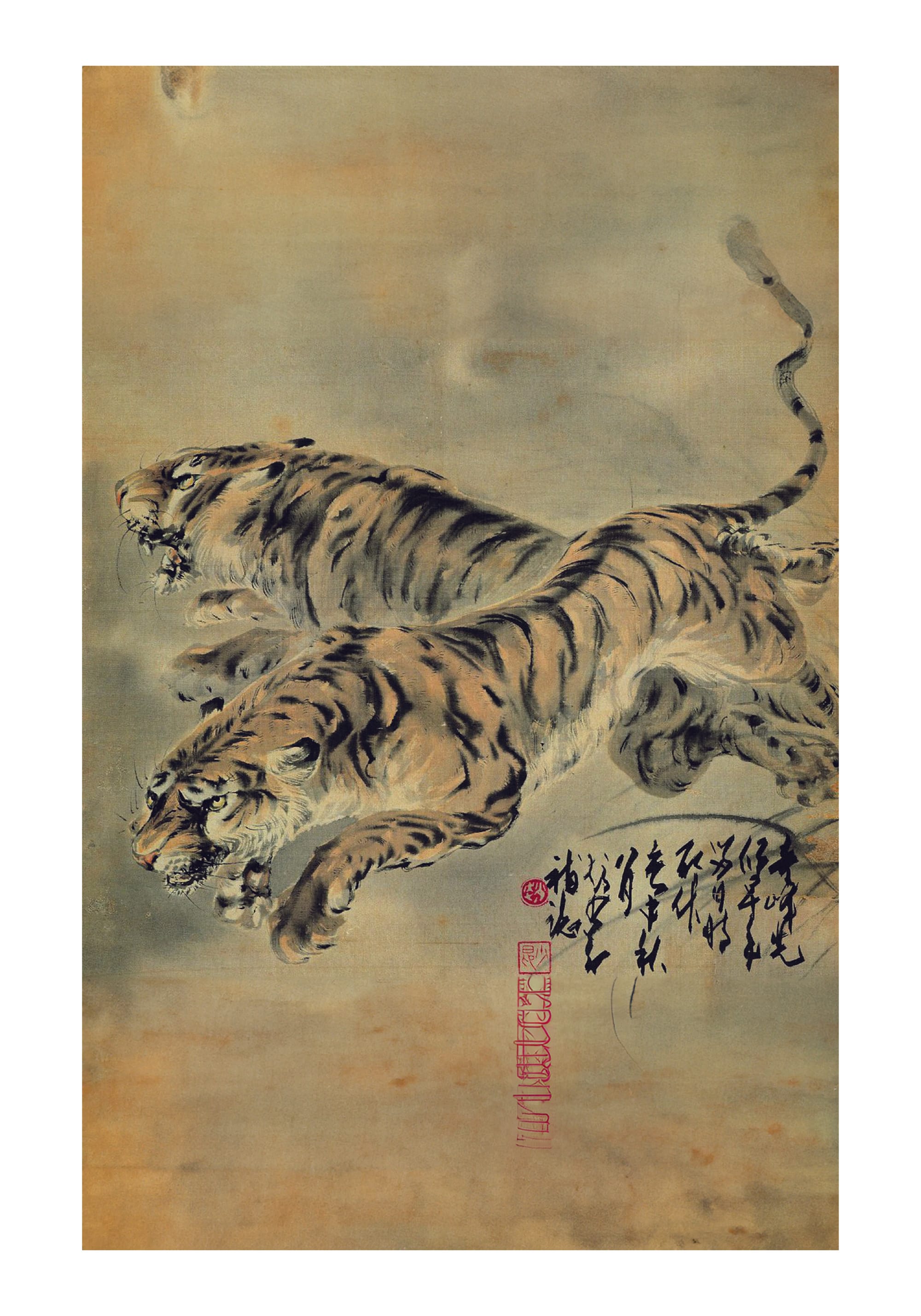
The Enigma of China
The tigers have a long history in China, the absence of tigers in China represents something far greater than a conservation case study. We can understand it as a manifestation of deeper tensions in contemporary Chinese identity—between tradition and modernity, indigenous culture and influence of foreigners, revolutionary upheaval and cultural continuity. To appreciate this story is to see past simple narratives of loss and towards the ways in which cultural change, political upheaval, and economic expansion have altered the relationship between China and its symbolic cultural heritage.
The tiger has, for over two millennia, been a deep motif in Chinese cosmology and culture. The meaning of the tiger, as part of a multifaceted set of meanings, structured Chinese understandings of natural order, political authority, and spiritual balance. The dragon and tiger pairing in ancient China represented two complementary forces—where the tiger embodied the dark, feminine energy of yin, but also embodied the masculine authority represented by the character for ‘king’ marked on her forehead. This apparent contradiction embodied the Chinese sophistication of thinking about the nature of power itself: true authority requires the combining of opposing forces, it did not mean one force exerting domination over another.
The development of Feng Shui as early as the second millennium BCE shows the depth of the tiger and dragon cosmology within Chinese civilization. Feng Shui translated literally as ‘Wind and Water’—wind represented the tiger and water the dragon—structured everything from urban planning to burial practices. The tiger was not just a fearsome predator to be feared or admired. It was an integral part of the cosmic order that birthed Chinese civilization itself.
The arrival of Buddhism around 200 CE demonstrates Chinese cultural ability to synthesize narratives rather than replace them. Instead of replacing tiger symbolism with Buddhist teachings, Buddhism incorporated the tiger in its own narratives about multiple lives of the Buddha, particularly the story about the Buddha sacrificing his life to feed a starving tigress. This instructive tale illustrates something significant about how traditional Chinese civilization has approached new foreign ideas, not seeking to completely incorporate them or reject them, but instead to creatively synthesize the foreign ideas with existing, already developed cultural foundations.
Breaking this cultural ecosystem was initiated when China encountered Western imperialism in the nineteenth century, but the real shift occurred during the revolutionary upheaval of the twentieth century. Both the Kuomintang and Communist governments, in different ways, sought to modernize China through a break from what they imagined were feudal traditions. Importantly, however, this modernization project relied on a significant contradiction: how do you build a strong, modern China with an unambiguous rejection of the cultural foundations that made China a special place historically?
The Communist project was especially radical. The declaration made during the Mao period that tigers were “pests” represented more than just a phase of environmental policy; it illustrated the determination of the Party to completely remake Chinese society from the bottom up. The complexity of traditional cosmology, which privileged balance and harmony with natural forces, was threatened by revolutionary ideology that purported to shape nature and society through human will and scientific planning. The tiger, a too-powerful cultural symbol to co-opt, and too inherently integrated in the cosmological model of cultural foundations to ignore, had to be eliminated.
The elimination of the tiger and tiger symbolism speaks to the complicated character of China’s relationship with its own past. The Chinese Revolution was a movement that was, at one time, an anti-imperialist movement for the authentic preservation of Chinese civilization, but also a modernizing project which demanded a rejection of some aspects of that civilization. The tiger became caught in this contradiction. The tiger was a quintessentially Chinese symbol, but it too had to be destroyed to create a new China.
The environmental effects of this violent symbolic act became clear in subsequent decades. The way in which the Great Leap Forward attacked the four pests (rat, fly, mosquito, and sparrow) was evident as campaigns based on ideology sometimes had terrible ecological results. The Cultural Revolution’s modern attack on traditional thought extended this ideology, because the attack on traditional culture targeted not just political opponents, but the broader framework of meaning that had culturally connected Chinese people to their landscapes over time.
Complicated does not only mean destruction, and even as the tiger’s traditional symbolism was eliminated through a mix of ecological politics and revolutionary action, new representations of Chinese identity were also being constructed. The dragon, which, after adjustment, became more efficient for the state model, was preserved as the rehabilitated symbol of pride of the Chinese nation. Tactically preserving the dragon does reveal something about the pragmatic dimension of cultural policy. Some traditions could be preserved and repurposed, while others insisted on total rejection.
The present impact of this history reaches far beyond China’s frontiers. As China has become a world power, the global conversation around cultural authenticity and national identity has intensified. The recent governmental focus on, “”cultural confidence,”” and its stated aim to revitalize traditional Chinese culture, are admissions of a deeper knowledge that sustainable power rests not solely on economic growth, but on an authentic cultural underlying.
Yet the project’s complexity deepens with the absence of the tiger. How do you restore cultural balance when you have erased half of a cosmic pairing? How do you claim to represent Chinese civilization when you uprooted one of its iconic symbols? The awkwardness of these questions is helpful in understanding why environmental protection is such a sensitive topic in contemporary China - it unfolds deeper questions about cultural identity and requiring development.
The comparison with other Asian civilizations is insightfully instructive. Despite the brutality of the Soviet regime, a few hundred tigers remain in the Russian Far East. The mere fact that few tigers survive tells a story of their distinct place in Russian history and historical memory that shaped cultural perceptions of the relationship between tradition and modernity. The complexity of Russia’s relationship retain some continuity with imperial memory; China’s more radical break with its own tradition left fewer spaces for memory to survive.
This thinking does not mean that Chinese culture is completely erased from its roots. Cultural resilience often operates below formal government policy, in family traditions, local practices, and in popular culture. For example, the rise of traditional Chinese medicine around the globe, martial practices, and classic literature, show that cultural memory persists alongside historical practices, advances, and new policies are introduced at an official level.
Thus, the disappearance of tiger from China reveals historical transformation and loss. The historical loss represents the dangers of revolutionary modernization, but also demonstrates the creativity of transforming and adapting and continuing to shape a vibrant contemporary Chinese culture. The challenge for contemporary China is to find the appropriate balance and signaling to honor its past without becoming subjugated to it; to learn from the historical experience, but not repeat it.
Understanding this challenge requires us to move beyond simple questions of cultural ‘destruction’ and ‘restoration.’ It requires us to explore the practical ways that modern societies formally and informally negotiate the relationship between tradition and change. China’s experience with the tiger, and the subjugation of the tiger, realist in both China’s history, but also, and helpfully, in the transition, loss, transformation of cultural identity in its larger modern narrative.
The tiger may be gone from the forests of China, but its symbolic legacy remains embedded within the contemporary culture and consciousness of China. The things of contemporary culture, and especially of contemporary history, and how it is remembered, or retold, or discarded, or new meanings assigned, through the lens of historical memory and continues to shape China’s meaning of culture on the broader world stage, of itself, and as a new place emerging in the modern world. The stripes of meaning may be faded, but the pattern it reveals of cultural complexity and the multiple identity negotiation either contemporary, or historical, remain as a cultural question as ever.
The Tiger is the perfect metaphor for China today, it is in direct competition with the United States, while trying to hold on to tenets of Chinese characteristics, something that is becoming harder to hold on to and define with broad acceptance even within China. The outcome of this struggle will shape not just China but also the vision for competing ideas of world order.
In this issue we take a closer look at China’s inherent power and paradox by analysing the processes shaping it.