

- Español
- Hindi
- Marathi
- Kannada
- 中文 (简体)
- Français
“Quite simply, you don’t get to do business in China today without doing exactly what the Chinese government wants you to do. Period. No one is immune. No one.”
Doug Guthrie, quoted in Patrick McGee, Apple in China, p. 348.
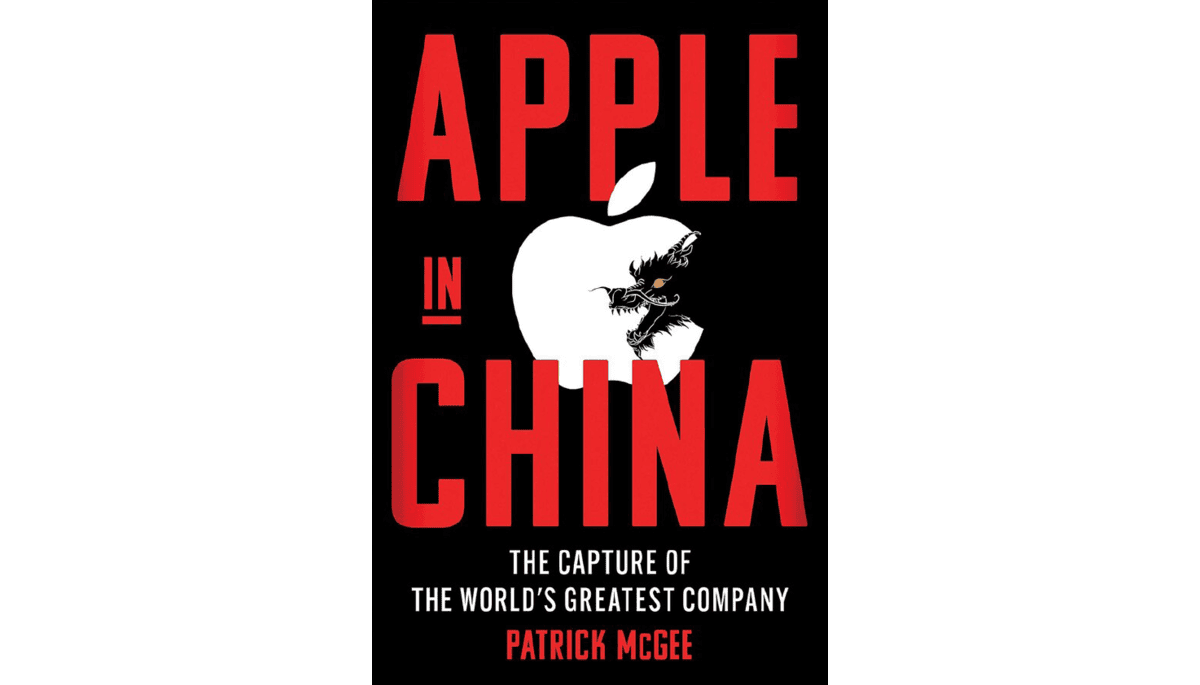
Patrick McGee’s Apple in China is less about Apple’s history and more about geopolitical tensions in the contemporary world. The book tells the story about how the world’s most famous and prized company built itself into a well-oiled manufacturing and design machine, putting all its eggs into one basket - China. It also explains how Apple has become so intertwined with a political system that has absolutely no interest in adopting liberal ways of governance. McGee argues that this is a story of triumph but with a deep sense of vulnerability. Apple and China’s relationship is mutually beneficial. By the mid-2000s Apple had understood that the level of production and efficiency it wanted to achieve was not possible in the US or Europe. China offered exactly what Apple wanted; efficiency, speed and large-scale production. Cheap labour was important, but not as much as building an entire ecosystem of supplies, skilled workers and engineers and logistical hubs that allowed Apple to work at a speed no rival could. McGee documents how China became the backbone of manufacturing Apple products with both Steve Jobs and Tim Cook pushing for partnerships.
Numbers convey how important China is for Apple. Apple invested a staggering $275 billion into China between 2016 and 2021. According to McGee, this number is more than twice the value of the Marshall plan after being adjusted for inflation. McGee goes a step forward and calls Apple’s investment a ‘Marshall Plan for China’. The Marshall Plan was a programme initiated by the United States to rehabilitate the economies of European countries, to promote democratic values and to contain the influence of the Soviet Union. In short, it had clear geopolitical intentions and plans. On the other hand, Apple’s investment in China was purely motivated by profit and were private corporate investments. Equating the two is unjust and it is extremely difficult to blend a geopolitical issue with a corporate motivation. This melodramatic comparison distracts the reader from the fair and logical argument that McGee is trying to make: Apple’s investment for China was revolutionary and transformational, somewhere overstating Apple’s uniqueness in China.
Foxconn remains at the heart of McGee’s book. Foxconn, a Taiwanese manufacturing company has now become synonymous with producing iPhones. McGee’s book shines when he is reporting and explaining the world of these production campuses in China, workers’ dorms, working conditions and hours and the sheer logistical organisation required to build a new iPhone from prototype to launch in only a few weeks. Foxconn became Apple’s most important partner in production and manufacturing. Apple did not simply hire Foxconn to make their products, it immersed itself in China and within an industrial ecosystem kept alive and subsidised by the Chinese state. Provincial governments and the Central government provided tax breaks, land, looser regulations and rules, infrastructure and the most important, migration of labour. The consequence was not just profit but also the transfer of knowledge. Millions of Chinese workers were trained by Apple which reshaped manufacturing standards in the country. McGee argues that this transformation helped China climb and lead the technology ladder and compete with rivals. However, Apple’s relationship with China is not just about Foxconn. McGee explains how Apple accelerated the growth of Shenzhen into one of the most dynamic industrial clusters. The city was originally designated as a Special Economic Zone by Deng Xiaoping in 1980. Once a small fishing village, the city became a dense network of suppliers, logistical hubs and trained engineers, all located in the same place to service Apple’s needs. The region’s industrial policy was shaped by Apple’s demands of efficiency, scale and production. Shenzhen was not only hosting Apple’s production, it was transformed by it and created lasting impacts for China as a whole. It took decades of state planning and investments to create what Shenzhen is today. This explains why India and Vietnam, though they are getting a small sliver of Apple’s supply chain, cannot recreate the Chinese model in the short run.
This transformation of China has a human side that is not ignored in this book. McGee reviews the surge of suicides at Foxconn in 2010, when a group of young workers killed themselves in protest against intolerable working conditions. Apple was forced into damage control mode and suicide nets were installed outside Foxconn dormitories. A number of surface level practices were conducted such as audits, reports about codes of conduct and supplier responsibility, but McGee argues how these practices could not fundamentally change a system built on intense pressure, long working hours and a demand for speed. Apple’s image as a global, high value brand clashes with the grim reality of workers that make their products. McGee reminds the reader that behind every shiny new iPhone is a human cost, borne disproportionately by migrant labourers with little voice of their own.
The political outcomes of this relationship are most concerning. McGee reveals that Apple created a ‘Gang of Eight’ to manage its problems with China. Their primary responsibility was to predict Chinese leaderships’ demands, fix problems and ensure Apple complied with any of the shifting regulations. The list of concessions provided by Apple is long and tells the reader of the political consequences of doing business in China. It accepted the government’s demand to store users’ iCloud data on state servers and stopped any kind of features that clashed with Chinese security laws. These decisions can be justified in terms of profit and market point of view but it largely tells the reader how Apple’s decisions are shaped by the demands of an authoritarian regime. The formation of the ‘Gang of Eight’ indicates that Apple was using its own form of corporate diplomacy and tells the reader how a private corporation can have its own foreign policy to deal with situations in an authoritarian context. This political dependency became more prominent when Xi Jinping came to power in 2013. Xi consolidated power and emphasised reducing reliance on foreign firms while regaining full control over domestic operations. This left Apple with very little room to move around. With Xi’s control over the state, regulations have become tighter, censorship has increased and the state has more authority over foreign firms. What started out as a mutually beneficial relationship became lopsided under Xi’s regime with Apple at the shorter end of the stick. This situation is not without its irony and McGee understands that well. Apple, which was once seen as a flagbearer of innovation, empowerment and modernisation has now become embedded in surviving in an authoritarian regime. Instead of bringing China closer to liberalisation, which the United States hoped to do many years ago, Apple has contributed to the longevity of the system by providing capital, training and knowledge transfer.
McGee also effectively explains how this dependency on China restricts Apple from diversifying. To escape tariffs and political tensions, Apple could fully shift operations and diversify to India and Vietnam but it would not be able to replicate overnight the complex web of suppliers, logistical operations and the industrial efficiency available in China. Thus, this reliance is not just about cost but also about operational possibility. To make matters worse, rising Chinese firms, some of which were born out of Apple’s intricate supply and manufacturing system are now directly competing with Apple. One of the most important competitors, Huawei, which was once weakened by sanctions from the United States government has made a strong comeback. Like others, it has also taken advantage of the Chinese supply chain that Apple once helped strengthen and has been able to reclaim the market share in the premium smartphone market. Huawei remains the most high-profile example but it definitely is not alone. Oppo, Xiaomi and Vivo also took advantage of Apple’s supply chain model. They made use and benefitted from access to the same trained workforce, logistical hubs and supplier base that Apple relied on. McGee uses these examples to argue that Apple’s success contained the seeds of its vulnerability. In trying to secure the most efficient production system in the world, it nurtured an ecosystem that could produce capable competitors. China is not just Apple’s factory, it is also one of the most important consumer markets. McGee points out that Apple’s growth in China heavily depends on the middle class that sees the iPhone as a status symbol. This dependence on the Chinese consumer market gives Beijing an upper hand and makes Apple more vulnerable to political leverage. If a wave of national boycotts or crackdowns hit Apple, it could lose a huge percent of its consumer base. In this sense, Apple is at a double disadvantage, it needs China to make its products as well as buy them.
Apple’s hardware needs are fulfilled by the Taiwan Semiconductor Manufacturing Company (TSMC), they produce the advanced chips for iPhones, iPads and Macs. This partnership between TSMC and Apple adds another layer of risk for the latter as according to McGee, disruption of any kind, be it a military conflict, political coercion or sanctions would be disastrous not only for Apple but for the entire technology industry around the world. Apple now finds itself caught in a strategic paradox by being reliant on a mainland system it cannot get out of and on an island that could witness military conflict and takeover at any given point. Xi Jinping’s repeated demand on ‘reunification’ with Taiwan, alongside the modernisation of the People’s Liberation Army, makes the dependency even more risky. It is also important to note that Taiwan lies on the most dangerous geopolitical fault line in the world, making it one of the most volatile regions in the world. For a company that wants to control every last detail of its supply chain, its future is one full of risks and dangers.
Making the situation more complex is the broader United States - China power struggle that Apple finds itself in the middle of. As Washington imposes export sanctions on advanced semiconductors, bans sales of certain chips to Chinese firms and debates bans and restrictions on Chinese apps like TikTok, Apple must constantly navigate and negotiate between its home country and the government of its most important market. McGee notes that many times, Apple is caught in the crossfire, the United States puts pressure on it to reduce its exposure to China, while China hints that Apple could be punished if the United States escalates sanctions. The book explains how Apple has been reduced to a pawn in the larger contest for technological supremacy which is a position no corporation or firm, no matter how wealthy, can manage. Apple’s dilemmas have therefore taken a geopolitical turn: how to remain profitable in China without betraying the commitments it made to the United States and how to reassure United States policymakers that doing business and depending on China does not pose a threat to its national security.
The book however has its flaws. The Marshall Plan comparison as noted above, is more distracting than informative. At other times, McGee also gives Apple the credit for China’s rapid industrial rise. Other giants like Samsung, Siemens and Volkswagen, to name a few, have also contributed immensely to China’s rise which cannot be credited to Apple alone. The book’s narrative also seems heavily tilted towards the western corporate perspective. As compared to Apple insiders, the voices of Chinese migrants and policymakers are less prominent, a limitation that narrows the scope. If a reader is reading this book to find out how countries and governments manage such companies and dependencies, they will find less guidance than expected. Nevertheless, these flaws do not take away from the book’s central contribution. McGee does a tremendous job of weaving together human and corporate stories and geopolitical context which forces the reader to understand how one of the most admired companies in the world is slowly becoming exposed. The entanglement of China’s rise and Apple’s success is now posing massive strategic risks. Global supply chains which were earlier created to make Apple’s production more efficient have led to risky dependencies. Despite being secretive, corporate diplomacy or the formation of the ‘Gang of Eight’ has tied Apple into the political space of an authoritarian regime. Even the transfer of knowledge has led to the rise of rivals capable enough to cut into Apple’s market share.
McGee’s writing is that of an investigative journalist. His writing is direct, accessible and full of anecdotes showing his experience of years reporting for the Financial Times. He particularly shines at taking the abstractions of geopolitics and grounding them in the lived realities of factory floors, executive negotiations and state demands. The book will appeal to those who want to understand what goes behind manufacturing their iPhones and what it tells them about the global world order. For analysts and policymakers, this book offers evidence and insight about globalisation, industrial strategy and the limits of corporate independence in authoritarian systems.
In the end, Apple in China is less about Apple and more about the structural realities of the world order in the 21st century. It is about the risk of assuming that private companies are shielded from geopolitical risks and threats. Xi Jinping’s China is definitely not the one Apple entered years ago, it has become more authoritative and controlling with Taiwan being Apple’s reason for survival. McGee’s book does serve as a warning but also provokes to think differently. For policymakers, Apple in China is an advisory about state-corporate dependencies. It reminds governments that corporations, however powerful, cannot be relied upon when national interests clash with corporate motives. For India, which is actively trying to get Apple and other global manufacturers to shift its production, the book offers both opportunity and risk. Building an ecosystem that can rival Shenzhen will take years and unless governments plan for resilience, they may find themselves hostage to the very firms they want to attract. For the United States and Europe, McGee’s reporting reinforces the need to build semiconductor resilience, diversifying supply chains and rethinking the assumption that trade automatically produces political liberalisation. McGee also situates Apple within China’s bigger industrial ambitions. The trained and skilled labour, networks and efficient production methods that Apple introduced have helped advance state initiatives such as ‘Made in China 2025’, which aims to upgrade the country from a low-cost assembly hub to one of high value innovation. Instead of pulling China into the United States led liberal order, Apple has become one of the most important driving forces of China’s technological ascent. The question is not only how Apple handles its dependencies but also how states and governments should respond to these insecurities when one of the most powerful and admirable firms in the world is intertwined with the most powerful authoritarian regime of our time. The answer to this question is not easy, but thanks to McGee, it is a question no one can ignore.