

- Español
- Hindi
- Marathi
- Kannada
- 中文 (简体)
- Français
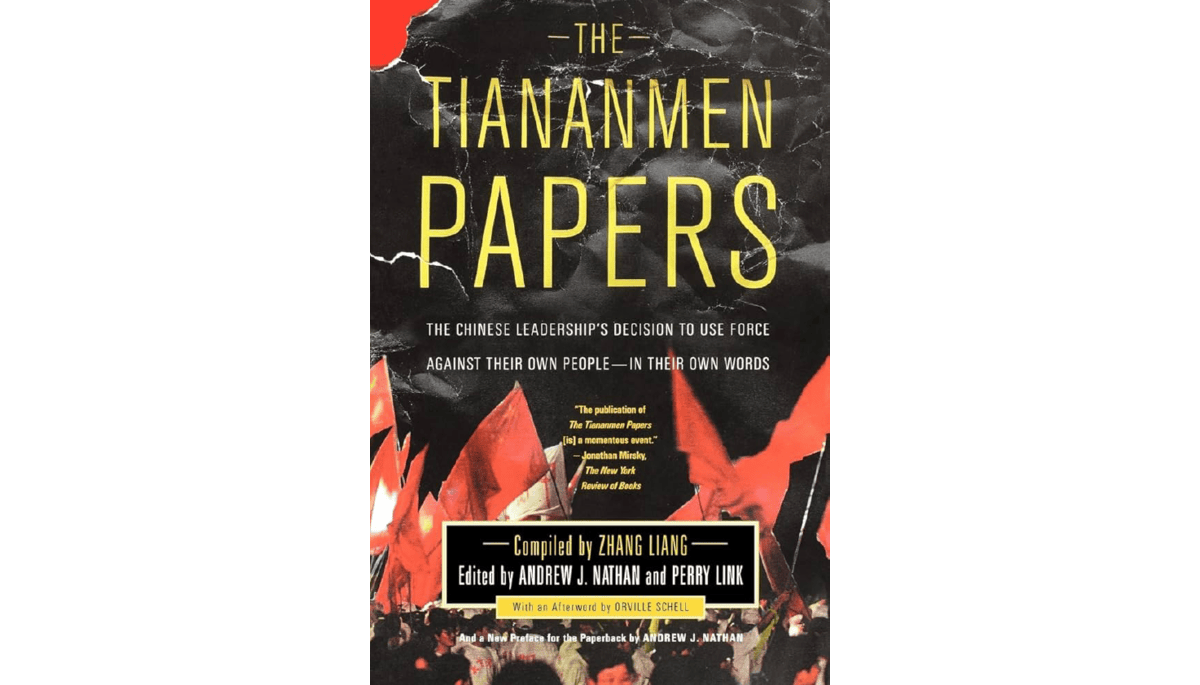
In 2001, The Tiananmen Papers created a huge sensation on its first appearance. Edited by Andrew J. Nathan and Perry Link, the book claims to contain leaked internal documents from the ruling Chinese Communist Party, offering an unusual window into the politics of decision-making that led to the violent suppression of the student-led protests in June 1989. For the first time, people outside the Party were able to see not just the outcome but also the tense debates, ideological clashes and personal anxieties that shaped one of modern China’s most defining events.
Two decades on, the text remains a vital source for understanding authoritarian politics across the globe. The book is both a historical archive and a political text, showing how rulers confronted dissent, fear and force.
Organised chronologically, it covers April to June 1989. It begins with the death of reformist leader Hu Yaobang, whose passing sparked spontaneous turnout in Beijing. From there, the documents trace the student demonstrations, the government’s increasingly sharp response, and the prolonged clash between reformists, led by Zhao Ziyang, and hardliners such as Premier Li Peng and Deng Xiaoping.
Through transcripts, meeting notes and directives, the book describes Zhongnanhai, the Party leadership compound, where debates about stability, socialism and “turmoil” dominated the agenda. The documents show how the decision to impose martial law was reached, unleashing the People’s Liberation Army onto the streets of Beijing — a decision that claimed thousands of lives and reshaped the trajectory of Chinese politics.
Demystification is the very nature of The Tiananmen Papers, which makes it compelling. Within academia it has been described as a glimpse into the “black box” of Chinese politics. In authoritarian systems, opacity is the rule. Decisions are made by a small circle of leaders, and dissent is subsequently buried. Yet here, in remarkable detail, competing voices are revealed.
Zhao Ziyang stood almost alone in advocating for dialogue and compromise, warning that repression would alienate the people and undermine reform. He was subsequently purged, placed under house arrest, and silenced for the rest of his life. Li Peng and Yang Shangkun urged the imposition of martial law, while Deng Xiaoping exercised decisive influence, framing the protests as a fundamental threat to socialism itself.
For readers, the reports illustrate how authoritarian governments view legitimacy: not as public approval but as stability. Authorities repeatedly summoned the spectre of “chaos” (luan), seeing in the students not simply idealistic young people but the seeds of revolution. Their alarms were partly justified, as the demonstrations had developed into a social movement involving workers and citizens. Yet the leap from protest to “counterrevolution” shows the rigid ideological lens through which the Party viewed dissent.
The book’s greatest strength is its immediacy. Reading minutes of meetings and transcripts of secret conversations among leaders creates a striking sense of proximity to power. The editors deserve credit for contextualising the documents, offering explanations and cross-references without overwhelming the narrative.
It also captures critical historical junctures. While the Tiananmen crackdown ultimately occurred, the documents reveal a series of crossroads: moments when dialogue might have prevailed, when compromise was almost within reach.
The book has not escaped scrutiny. Questions were raised about the authenticity of the documents, given that their sources remained anonymous. While many experts have accepted their credibility, the lack of verifiability remains a limitation.
Another shortcoming is the absence of student voices. The documents focus on Party leaders, making the book heavily elite-centred. We do not hear from the students, workers or citizens who occupied Tiananmen Square. Their experiences must instead be sought in memoirs, journalistic reports and oral histories. Readers should therefore treat the book as only half the story: the view from the top, not from below.
Accessibility is also an issue. At times the documents are repetitive and bureaucratic, which may daunt readers unfamiliar with Chinese politics. References to committees and protocols add to the density. Yet perseverance is worthwhile: once immersed, readers gain a rare education in the language and psychology of authoritarianism.
Finally, the book implicitly valorises democracy, reform and individual freedom as “good.” This frames the narrative as a “missed opportunity for democratisation,” a view that aligns with Western notions of progress but does not necessarily reflect China’s own political trajectory.
The significance of The Tiananmen Papers in 2025 lies, first, in the fact that the documents it contains continue to shape China’s politics. The Party has successfully erased Tiananmen from public memory, ensuring younger generations have little or no access to information about it. Yet the legacy of mass protest, the obsession with stability and discipline, and the intolerance of dissent remain hallmarks of Chinese governance.
Second, the book illuminates the nature of authoritarian governments beyond China. Across the world, such regimes confront protests and movements demanding accountability and freedom. The politics of the Tiananmen massacre, and the calculations of Deng Xiaoping and his colleagues — deciding when to compromise and when to repress — resemble dynamics seen elsewhere, from Moscow to Tehran. Reading these clandestine documents is to witness authoritarian logic at work, in real time.
Lastly, the book reminds us of the fragility of reform. Zhao Ziyang’s voice is haunting because it represents a road not taken. His downfall symbolises the closure of China’s brief window of political openness during the 1980s. Today, as China extends its global influence, it is worth remembering how contested its path once was.
Although scholarly in substance, The Tiananmen Papers is not scholarly in tone. Nathan and Link intended it for a general readership, and their annotations make it accessible. Nevertheless, the density of information demands patience. It may be most useful for readers to approach the book step by step, following events chronologically rather than attempting to read it cover to cover in a single sitting.
The Tiananmen Papers is not just a book but an archive of history. Its contents expose the way authoritarian leaders think, fear and make decisions. It is essential reading for students of Chinese politics, authoritarianism and the vulnerabilities of democracy. While limited by questions of authenticity, elite bias and density, it remains a path-breaking publication, unrivalled in its power to penetrate the veil of secrecy surrounding the Chinese state.
For those who want to understand how regimes legitimise repression, and how voices of reform are silenced, this book is indispensable. It is not easy reading, but it is required reading.