- Español
- Hindi
- Marathi
- Kannada
- 中文 (简体)
- Français
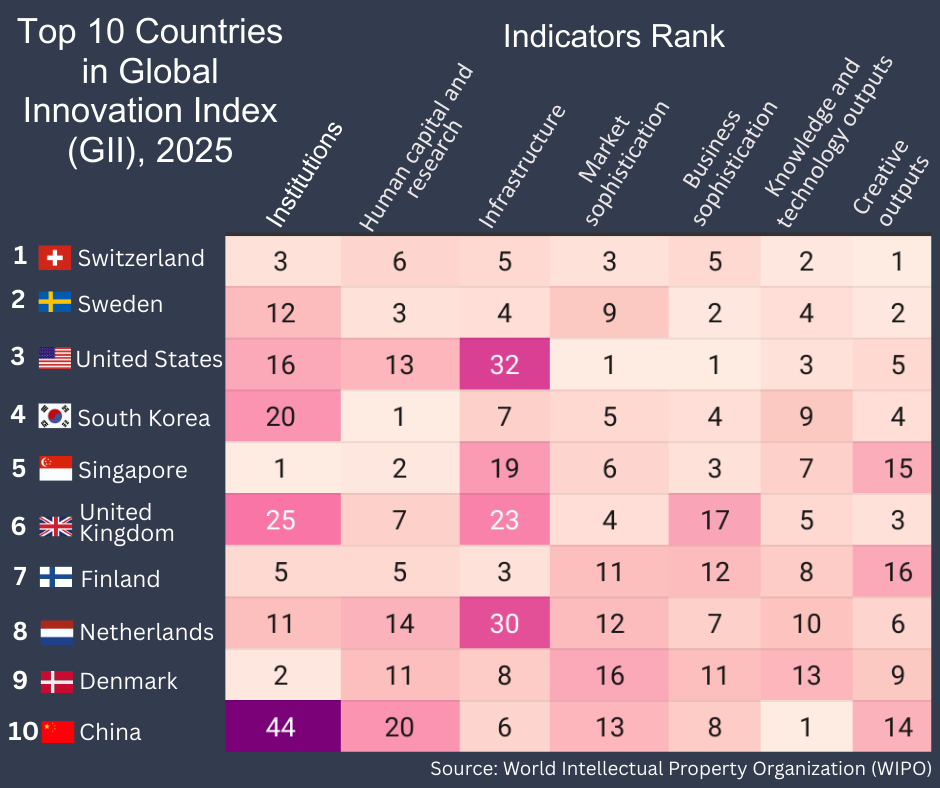
World Intellectual Property Organisation (WIPO) has released its latest edition of Global Innovation Index (GII). China has entered the top 10 in innovation for the first time by ranking 10th globally, positioning China as the only middle-income economy within the top 30. Over the past decade, China’s rise in has been steady, systematic, and tied closely to reforms in its intellectual property system. Moving from the 25th position in 2016 to finally breaking into the global top ten in 2025, China has reshaped its profile from an emerging innovator to a global innovation leader. The numbers tell one story, but behind them lies a deeper context: sustained investment in research and development (R&D), the strengthening of intellectual property (IP) law, the rapid growth of patenting capacity, and the creation of a domestic environment where innovation is both incentivised and protected. (WIPO, 2025)
China’s rise is particularly striking compared to peers. High-income economies like South Korea and Singapore have long ranked in the top 10, but they started from a stronger institutional base. China, as a middle-income economy, is unique in making its rapid entry to the top tier. Throughout 2016- 2025, it has been the only middle-income country among the top 30, underscoring the distinctiveness of its trajectory. (WIPO, 2025)
China’s rank of 25th in 2016 placed it ahead of most middle-income economies, but far behind global leaders. By 2018, it had broken into the top 20 (17th), a symbolic milestone that drew international attention. The climb continued, 14th in 2019 and 2020, 12th in 2021, 11th in 2022, and although it slipped briefly to 12th in 2023, it regained momentum in 2024 at 11th. Finally, in 2025, China entered the top 10 for the first time. Its GII score rose too, from about 50.6 in 2016 to over 56 by 2025. Unlike more volatile economies, China’s rise was gradual, a sign of structural changes rather than temporary boosts. (WIPO, 2025)
Outputs Outpacing Inputs
One consistent pattern is the imbalance between China’s innovation inputs and outputs. On the Input Sub-Index, which measures institutions, human capital, infrastructure, and market sophistication, China has performed respectably but not at the level of the very top economies. On the Output Sub- Index, however, China consistently overperforms, often ranking in the top five globally.
That gap is explained by how efficiently China converts resources into measurable results: patents, publications, high-tech exports, and creative goods. Patent numbers tell the story best. In 2023, China granted a record 921,000 invention patents, alongside 2.09 million utility model patents and 638,000 design patents. By the end of that year, it became the first country in the world to surpass 4 million valid invention patents (CNIPA, 2024). CNIPA, its patent office, granted nearly three times as many patents as the USPTO. Globally, innovators residing in China filed about 1.64 million patent applications in 2023, of which over 120,000 were filed abroad. (WIPO 2024)
The examination system has been streamlined to keep pace. The average review time for invention patents has dropped to about 15.5 months, making China one of the fastest jurisdictions worldwide. To handle rising volumes, CNIPA has expanded its examiner base to more than 16,000 and set up seven regional offices (CNIPA, 2024). Specialised centers now process AI-related pre-examination requests, handling 46,000 such requests in 2023 alone. Around 31,000 AI patents were granted via fast-track review, directly feeding the growth of China’s AI industry. (CNIPA, 2025)
Innovation Clusters and Regional Hubs
The GII also measures science and technology clusters. Here, China is unrivalled. In 2025, it had 24 clusters in the world’s top 100, down slightly from 26, but still more than any other country. Shenzhen–Hong Kong–Guangzhou topped the global ranking, overtaking Tokyo–Yokohama. The cluster alone accounted for nearly 10 percent of global PCT filings between 2020 and 2024, led by Huawei and anchored by research institutions like Sun Yat Sen University. (WIPO, 2025)
Other leading hubs, Beijing, Shanghai–Suzhou, Hangzhou, Nanjing, Wuhan, combine the weight of universities, companies, and local governments. Some, like Ningde (driven by CATL’s dominance in battery technology), now feature in the top 100 for the first time. Together, these hubs highlight how China’s innovation is geographically concentrated, but globally competitive in scale and intensity. (WIPO, 2025)
Green Technology and Global Leadership
China’s top ranking is not only about numbers, but also about direction. Green technology is a clear example. By 2024, China had filed 6,356 PCT applications in green and low-carbon technologies, 2.3 times more than in 2020, cementing its lead for the fourth consecutive year. It is also the largest contributor to WIPO GREEN, with over 12,000 technology solutions shared. (CNIPA, 2025)
The broader context is China’s role as both the largest emitter of greenhouse gases and the largest investor in renewable energy. In 2022, it invested USD 546 billion, almost half of global renewable investment (World Economic Forum, 2023). It dominates solar panel manufacturing (80% of global capacity), has the world’s largest wind and hydropower markets, and controls three-quarters of global lithium-ion battery production. This alignment of industrial policy, IP filings, and climate goals underscores how China is shaping the future of both green industries and IP-driven growth.
Challenges on the Input Side
Still, China’s weaknesses remain. It underperforms in institutions, financial market depth, and regulatory quality. Despite major campaigns, counterfeit goods and enforcement gaps persist, and allegations of IP theft continue to shape international perceptions. The emphasis on resident filings, over 90 percent of CNIPA applications, shows how domestic activity drives the numbers. This imbalance between domestic and international reach highlights the next challenge: converting quantitative dominance into qualitative influence abroad. (WIPO, 2025)
Entering the Top 10
Breaking into the top 10 in 2025 signals not only recognition but a new phase of competition. For China, it validates decades of policy linking growth with innovation-driven development. For the global system, it marks the center of innovation gravity shifting decisively toward Asia. China’s rise in renewable energy patents, AI filings, and ICT technologies shows that it is no longer just catching up, it is increasingly shaping the frontier.
Conclusion
Forty years ago, patents were seen in China as incompatible with socialist ideals. The 1984 Patent Law was a tentative experiment, revised in 1992 and 2000 to meet WTO requirements. The turning point came in 2008, when the law was revised not just for compliance but to serve national development. In 2020, punitive damages and higher compensation limits transformed enforcement. By the mid- 2020s, specialised IP courts and rapid pre-examination centers had turned China into one of the fastest, most prolific IP offices in the world (China Briefing, 2024)
From hesitant beginnings in the 1980s to more than 5 million patents in force by 2023, China’s trajectory shows how law, policy, and R&D investment can combine to remake a global innovation profile. Entering the top 10 of the GII is not the end point, but one more milestone in China’s emergence as a central actor shaping the future of global innovation.