

- Español
- Hindi
- Marathi
- Kannada
- 中文 (简体)
- Français
Preparing for the Dream: Elite Leaders Speak at Party Anniversaries
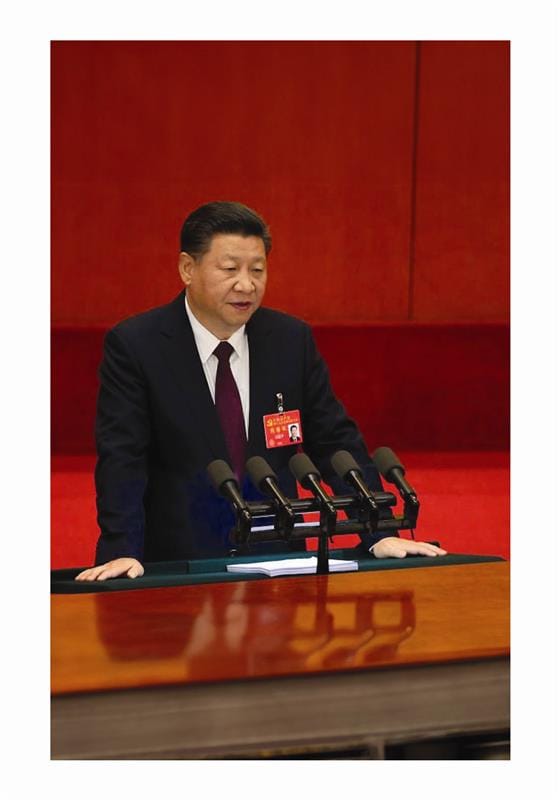
“China Dream” is where both the language of fact and feeling elide. This can be illustrated by many different kinds of events and examples from the Xi era after 2012. One of the most striking was the celebration by the Communist Party of China of its 100th anniversary on 1 July 2021. On that day, Xi spoke of the CPC with a tone of confidence and assertiveness, and of it leading a country that had delivered modernity on its own terms. The CPC was now able to face the world as at least an equal, and perhaps even a superior. This was an achievement that clearly needed not just intellectual acknowledgement, but an appropriate emotional response too (Xi, 2021). On this anniversary, Xi was addressing a national Chinese audience where most listeners may not have bothered much about the formal ideology of the party and its specific doctrines and technical ideas, but where they were predominantly invited to respond to the increasing evidence that nationalistic feelings were a valid emotional response to the situation the entity the CPC represented – the nation China – was in. This “rejuvenated nation” spoken of that day, rather than the CPC itself, could arouse people’s pride and affection because it was a worthy object of admiration and love through the size of its economy, the geopolitical impact it was having, the size of its military, and the physical transformation of its modernised landscape, along with its lauded cultural attributes. These were inevitably all things that Xi spoke of that day.
This specific performance showed where the Xi era and earlier Chinese times differed. Elite leaders in the past did not have this array of assets that Xi could deploy to trigger the happy, proud, nationalistic feelings of the public they spoke to, in order to “sell” its core message to them. For Mao, speaking at the very genesis of the PRC over seven decades before of its newness as a nation, the sources of happiness and the cultivation of love towards this new country were clearly things his language encouraged but more in terms of hope than current reality:
We are proclaiming the founding of the People’s Republic of China. From now on our nation will belong to the community of the peace-loving and freedom-loving nations of the world and work courageously and industriously to foster its own civilization and well-being and at the same time to promote world peace and freedom. Ours will no longer be a nation subject to insult and humiliation. We have stood up. Our revolution has won the sympathy and acclaim of the people of all countries. We have friends all over the world. (Mao, 1949b)
The language here is about the future, of what “will” happen, and of how China “will no longer” be a certain thing. China may have “stood up” and won sympathy, but the onus is on how things will happen going forward, and how the “insult and humiliation” of the recent past will now be consigned to history.
In the far more institutionalised context of half a century later, Mao’s successor but one as core leader, Jiang Zemin, could speak in stirring ways as Party Secretary and President in 2001. His confidence could come from the fact that the eighty-year-old party, having enjoyed half a century in power, had tangible evidence of its successes and contributions to draw on. While he had used this occasion to promote the main ideology associated with his era – the Three Represents (where private business entrepreneurs were eventually allowed to become CPC members) – he did so in language which was also aspirational and future-orientated, like Mao’s:
In the new century, the great historical tasks for our Party are to continue the modernization drive, accomplish the great cause of the reunification of our motherland, safeguard world peace and promote common development. Facing the profound changes in the domestic and international situations, our Party should follow closely the progressive trends of the world and unite and lead people of all ethnic groups throughout the country in seizing the opportunities and taking up challenges to accomplish the three major historical tasks successfully. To this end, we must unswervingly fulfil the requirements of the “Three Represents.” (Jiang, 2021)
This is the language of a great project, a work in progress. It is pragmatic, realistic, and almost humble in its tone. And here is the moment that Hu Jintao, ten years later, marking his own ideological innovation, Scientific Development, in his speech celebrating the ninetieth anniversary of the CPC, tied everything to the hope and desire for national rebirth:
In contemporary China, only development counts, and this calls for pursuing scientific development. We should take scientific development as the goal and give priority to accelerating the shift of model of economic development…We will promote fairness and justice; long- term, steady and rapid economic development; and social harmony and stability. We will continue to make new and greater achievements in pursuing civilized development that leads to increased production, better lives for the people, and a sound ecosystem, and thus lay a more solid foundation for building a moderately prosperous society in all respects and realizing the great rejuvenation of the Chinese nation. (Hu, 2011).
In all of these, the sense of aspiration, of bringing something about in terms of China’s recreation, are clear – whether they be conveyed through Mao and the sense of victimisation and China standing up, or by Jiang’s notion of historic tasks, reunification and modernisation, or by Hu and the construction of a rejuvenated, better society.
Each of the elite leaders spoke as much about the hopes for the future as they did about the present reality the country was in. Each was implicitly saying those good things that their listeners should like and feel happy about were going to happen because of changes in the current situation. Hope and desire are fundamental emotions. They contain evaluations of one of the most complex and unknowable things – the future. What none of these leaders did, however, was to deploy one of the most frequent terms used about thinking, and feeling, about the future – the word “dream.”
Dreaming Together or Dreaming Alone
One of the reasons for this can be found in the ways “dreaming” links to the notion of an individual and a person. One can imagine even for an idealistic and Utopian such as Mao, using a word like “dream” would have raised uncomfortable echoes of the ultimate capitalist idea – “the American dream.” Dreaming was something private, self-centred, and indulgent. The collectivist ethos underpinning Mao, Jiang, and Hu’s statements is power- fully present. Their recognition, for instance, in each of the statements above that they were speaking in a moment when all Chinese people had worked together, committed to a common enterprise, either of national foundation or national reconstruction or national economic reopening. Emotions are clearly stirred in this language, and through the ambitions alluded to, but more on the social rather than the individual level. Despite the underlying similarities in terms of encouragement of key positive public emotions, built on a shared concentration on China the great nation and a shared narrative and understanding about its modern history, the context in which each of these statements was delivered was always changing and evolving. This essentially created the quandary for Xi when he became the core of the “fifth generation of leaders” in 2012. The Maoist society dominated by collectivist social organisation, mass campaigns, and strict enforcement of CPC norms and economic behaviour had dramatically changed after 1978. Economic liberalisation alone led to a transformed society, where, as Arthur Kleiman et al. (2011) recognised, by the end of the Hu era there was often rampant individualism, some of it verging on almost pathological hedonism. The rise of these new forms of individualism can be found in the radical changes in the country’s material circumstances. From 1980 onwards, economic policies started to have impact. Specific results of these could be witnessed, measured, spoken about, and offered as evidence of success. These had tangibility. This is not to say that in the Mao era there were no material improvements in people’s lives. But these material developments had also occurred in a complex situation where there were crises, from the famines of the early 1960s to the widespread social instability from 1966 onwards. Under Deng, commitment was made to simplifying the party and its elite leaders’ key message, and their main mission – to make China materially wealthy while preserving the one-party system. Dense deployment of economic data became a key means of getting this message across, embodying the changes happening in people’s lives, and conveying success. The dialectic/argument function dominated. People needed to be persuaded to engage in this practical process of national material enrichment, rather than aroused to feel in a certain way about larger, longer-term abstract national goals. The audience for elite leaders were ones that did not have to principally feel happy, angry, indignant, or bitter – but to simply produce. Language such as that produced by Hu Jintao in 2003 epitomises this, showing that statistics have taken control:
I know you are all interested in China’s current economic situation and future trends of development…. From 1978 to 2002, China registered an average annual GDP growth rate of 9.4%. In 2002, when world economy experienced a growth slowdown, Chinese economy grew by 8%. In the first half of this year, China’s GDP went up by 8.2% despite the interruption by SARS. At present, China’s economy remains in good shape with a strong momentum for expansion. The 7% increase target set for this year is well within reach (Hu, 2003). This is the message of the prudent accountant, not the leader of a party historically committed to revolutionary change. But it does display a communication strategy, where the audience is offered empirical evidence which can speak for itself, about how the country is progressing and growing. This is indeed the discourse of “seeking truth from facts” where there is an unproblematic relationship between what is described and what conclusions intellectually can be drawn from this. What linked Hu’s language to that of Jiang and Mao was the sharing of a historic narrative of positive progressive development and the commitment to stimulating excitement about the future. The latter was where the most emotional energy was generated from – a sense of expectation and direction. In the “Cultural Contradictions of Capitalism” Daniel Bell (1976) had spoken of how capitalist societies were frequently infected by a constant fetishisation of the future. The future would always be better, things would be faster, easier, and more luxurious. This offers a common point with socialism with Chinese characteristics – a hunger for tomorrow not only being better but showing this in its results – the ever-climbing figure of GDP for example that always went up, never into recession. In the Mao foundational stage, there was a tomorrow at all in view of the horrific death and destruction that had preceded this during the Civil War and the Sino-Japanese War was, in itself, a positive and unifying message to give. It will, as Mao said in 1949, “lead the people of the whole country in surmounting all difficulties and undertaking large-scale construction in the economic and cultural spheres to eliminate the poverty and ignorance inherited from the old China” (Mao, 1949a), the place that everyone was fleeing from. As the PRC proceeded though, expectations also changed. It was no longer about simply surviving, though that remained important through many of the hardest Mao years, but eventually, after 1978, about prospering. Indeed, by the time of Hu, it started to be about even more than that – about thriving, and somehow dealing with the excesses of wealth and material goods that had been created.
Xi Jinping: Dreaming About Feeling Together
Clearly between the Hu and Xi eras there was a rethink of how the party was managing its public messaging. The dense and impersonal Hu era style was no longer adequate. There needed to be recognition that while promoting strong collective narratives and accepted facts and interpretation of the party’s achievements was important, this was happening in a context where individualism in China was an unchangeable new reality. The party therefore had to create at least some kind of register where despite this profound change it could still mobilise and motivate people and create a language which did not just instruct but inspired and engaged not just on the public, collective level, but down to the individual. The era of the rhetoric/storytelling function had returned. In 2012, Xi deployed a different kind of language, using reference to his own life story, something Hu, Jiang, and Deng had never done and conveying the China story in a more concrete, less technocratic language. Speaking in Seattle during a visit to the US in 2015, he stated:
Towards the end of the 1960s when I was in my teens, I was sent from Beijing to work as a farmer in a small village of Liangjiahe near Yan’an of Shaanxi Province, where I spent seven years. At that time, the villagers and I lived in “earth caves” and slept on “earth beds”. Life was very hard. There was no meat in our diet for months. I knew what the villagers wanted the most. Later I became the village’s party secretary and began to lead the villagers production. I understood their needs. One thing I wished most at the time was to make it possible for the villagers to have meat and have it often. But it was very difficult for such a wish to come true in those years. At the Spring Festival early this year, I returned to the village. I saw blacktop roads. Now living in houses with bricks and tiles, the villagers had Internet access. Elderly folks had basic old-age care and all villagers had medical care coverage. Children were in school. Of course, meat was readily available. This made me keenly aware that the Chinese dream is after all a dream of the people. We can fulfill the Chinese dream only when we link it with our people’s yearning for a better life (Xi, 2015).
The statistics of the Hu era largely disappeared. Not just storytelling, but one in which Xi figures as an individual have come to the fore – albeit an individual with a strongly representative and symbolic function. Alongside this, more complex issues have been recognised, such as the need for cleaner governance within the party itself, the desire to address inequality through the common prosperity language from 2021, and the notion that China was seeking greater autonomy through its “dual circulation” policy from 2020. Nationalistic pride, however, was growing stronger, simply because through economic growth and geopolitical developments, the country had more to feel proud about. The political challenge for Xi and his colleagues was how to find the best language to encourage, and exploit, this pride, and to allow Chinese people to feel rather than just know about their country’s achievements. This question of audience is a key one for any communication practice and strategy. It is striking that, for all the changes in people’s daily lives in the country, and the rise of this individualism and social differentiation within society, both Mao and Xi talked of their serving and speaking directly to their core audience – the very generic notion of “the People.” This term has remained remarkably static, despite all the changes going on around it. On 15 November 2012, when Xi emerged on the stage of the Great Hall of the People as the key leader, while setting out a number of core proposals for his new administration, he stated that “It is the people who create history.” The party’s task, he went on, was to “maintain close ties with the people” (BBC, 2012). This echoed the celebrated speech of September 1944, “Serve the People,” when Mao had talked of “the common revolutionary objective” – to lift the suffering of the Chinese people (Mao, 1944). That they both said they were talking to this group is one thing. But what did they signify by this term? Surely conceptualisation of it had not remained unchanged over the decades? Of all the terms in Modern Chinese political discourse, in fact, few can be more contentious than that of “people” . The contemporary Chinese writer Yu Hua wrote that these characters “renmin” were both “remote, but …so familiar too” (Yu, 2012: 3). But he offered an excellent insight into something fundamental that had changed about what this term referred to, and why Xi’s use of it was so different to Mao’s. Once upon a time, Yu stated, during the Cultural Revolution, the definition of “the people” could not have been simpler, namely “workers, peasants, soldiers, scholars, merchants.” But after that, “new vocabulary started sprouting up everywhere – netizens, stock traders, fund holders, celebrity fans, laid-off workers, migrant labourers and so on – slicing into smaller pieces the already faded concept that was ‘the people’” (Yu, 2012: 6). The “people” had become atomised, complex and diverse.
For Mao, there were clear and elemental moral distinctions between the “good” and the “bad” people, and that was all. You were an enemy or a friend. For Xi, the “people,” the audience he spoke to might have still been figured as though they were one great collective. But his tone of almost self-deprecation and respect to this great mass, and the fact that Chinese people were clearly socially, culturally, and economically more diverse than ever before, marked a massive difference. “During the long process of history, by relying on our own diligence, courage and wisdom, Chinese people have opened up a good and beautiful home where all ethnic groups live in harmony and fos- tered an excellent culture that never fades,” Xi stated. The use of “we” is rhetorically crucial here. Xi was speaking as one of those he was addressing. He was on the podium, for sure. But he was also asserting he was in the crowd listening too (BBC, 2012). Moving these people while recognising the vast complexity contained within them, trying despite this to speak directly to them, as one of them, recruiting them into a narrative carrying clear evaluations that will lead to emotional responses – these have clearly been major objectives of the Xi era. But as the occasion of the 100th anniversary of the foundation of the CPC, made clear, when Xi spoke once more to his audience he used a crucial new term – the party, he stated, at a 100 years old, was not just in the business of thinking, or planning, or doing, but also dreaming – and doing so with confidence:
To realise national rejuvenation, the party has united and led the Chinese people in pursuing a great struggle, a great project, a great cause, and a great dream through a spirit of self- confidence, self-reliance, and innovation, achieving great success for socialism with Chinese characteristics in the new era. We Chinese are a people who uphold justice and are not intimidated by threats of force. As a nation, we have a strong sense of pride and confidence. We have never bullied, oppressed, or subjugated the people of any other country, and we never will. By the same token, we will never allow any foreign force to bully, oppress, or subjugate us. Anyone who would attempt to do so will find themselves on a collision course with a great wall of steel forged by over 1.4 billion Chinese people (Xi, 2021).
“Dream” is a profoundly significant term here. This issue of Chinese people being invited by their leaders to dream is a new development. It says something important about the evolution of the role of aspiration in contemporary China, and the space now being granted to it by political leaders – something that has grown from the language of previous elite leaders but which is now located in a very different context and with a different kind of content and usage. It also marks a deeper acceptance of the individualism of the people being spoken to, and of there needed to be acknowledgement of their having the agency to take this offer to “dream” and shape it to their own unique circumstances.
The act of dreaming itself as it occurs in Chinese literary and historic traditions is a well-attested one, and something that the contemporary discourse of a national and per- sonal dream calls on. In his excellent book on the China Dreamscape during the era from 300 BCE to 800 CE, Robert Ford Campany (2020) writes of the huge importance given through divination and a complex set of interpretative tools by Chinese writers and thinkers over this period to dreams. But looking at this history today one thing is certain: dreams have always been regarded as carrying meaning. “Questions about dreaming were inextricable bound up with questions about how best to live,” Campany (2020: 67) writes.
Despite this, Mao himself seldom if ever mentioned dreams to address this issue of capturing aspirations, hopes, and desires about the future. He certainly did not convey any of his more significant statements or slogans by referring to dreams. For much of the post-reform era, in many ways beyond standard patriotic language party elite leaders have almost withdrawn from speaking in an emotional register, but simply kept to the business of informing, ordering, and quantifying. Using the language of dreams therefore bespeaks an important shift – an acknowledgement that the party once more needs to get back into the business of arousing and inspiring emotions and using these as part of its political strategy.
Deploying the language of dreams certainly opens up interesting new spaces for political discourse in contemporary China. It does go some way towards solving the conundrum of how to accept the rise of individualism in society, and also the need to have language that can arouse people’s feelings but do so in a way which is controllable by the party-state and hitched to its own goals. Appealing to dreams allows plenty of space for different sorts of evaluations of different kinds of reality – it is a very open and vague term. In the way the word is used by Xi, the one thing which is certain is that these qualities of being individual, varied and almost worldly are regarded as positive things. The party knows unlike in the Mao era it cannot command so easily but needs to carry at least some elements of persuasion. Inviting to dream is an uncontentious thing to do, especially as it does not need to say what the dream might specifically be about beyond better living standards, and a great, powerful, strong country. The main thing is to ensure that the dream itself can be a shared one. This is the way in which Xi spoke when he first deployed the term in 2013: “Everyone has an ideal, ambition and dream,” he said. But then he went on, in an act of party appropriation: “In my opinion, achieving the rejuvenation of the Chinese nation has been the greatest dream of the Chinese people since the advent of modern times.” This is not just a thing shared by people at a particular time: “This dream embodies the long-cherished hope of several generations of the Chinese people, gives expression to the overall interests of the Chinese nation and the Chinese people, and represents the shared aspirations of all the sons and daughters of the Chinese nation” (Xi, 2014: 38). This elision of language from past eras about the aspirations the party’s elite leaders expressed then, along with their accompanying emotions, and the context of a China that, after four decades of economic and material enrichment could now allow itself the luxury to dream, and to stand a chance of seeing those dreams come to reality, creates the peculiar sub-discourse within Xi speak for this term. In May 2013, he declared that “the Chinese dream pertains to the past and the present, but also the future.” This idea of dreaming about the past belongs more to the traditional use of the term – much as people often dream in their sleep about what has happened to them. But the second definition of dreaming, which is closer to the sense of hoping, aspiring, and wishing for, is also important here – nodding to the future. So is the sense of tangibility:
The Chinese dream is the dream of the country and the nation but also of every ordinary Chinese. One can only do well when one’s country and nation do well…. The great renewal of the Chinese nation will eventually become a reality in the course of the successive efforts of youth (Xi, 2014: 53).
The situation of China today is, for Xi, best seen as also a dream fulfilled. We often hear that people of the Maoist era who survived into the current one feel that they would never have dreamed of China being in the position it is today, with the levels of development it has. But for a politician sitting at the top of the communist party, this is a complex story to gather into one phrase that can then generate positive emotions to go beyond simple intellectual acknowledgement. To compound the challenge, the status of the party, the diversity of the audience, and the complexity coming from different technological platforms all mean that it is very hard to say one thing that will reach and speak to everyone and make them feel the way the party wants them to. Dreaming is one of the very few – a state of emotional receptivity, but without any overt emotions necessarily linked with it. One could dream and be happy, fulfilled, ecstatic, pleasantly confused, satiated, and thrilled – the choice is yours. The main thing is just to dream. The feelings start flowing after that.
Conclusion
Language both to communicate instructions, interpretations and facts, but also to promote a set of emotional responses has been an essential part of political life in contemporary China – as it has in any community. The Communist Party of China’s five core elite leaders since 1949 have all used a mixture of language in their main communications which instructs, commands, and informs, but also aims to inspire, mobilise people listening emotionally, and create emotions ranging from love to hate, and fear to pride. This does not mean these kinds of languages are utterly distinct from each other. As Solomon’s work argues, emotions are evaluations of situations and circumstances, albeit complex ones, and ones with a logic of their own.
The CPC’s leadership, through its language used at core public occasions such as celebrations of party anniversaries, illustrates the evolution of the relationship between language to inform, and language to inspire and talk to people’s emotions, over the last eighty years. While Mao certainly did deploy terms laden with reference to victimisation, Chinese standing up, and the need for a new sense of pride and hope, for Deng, Jiang and Hu, the commitment to a more prosaic politics of building better material lifestyles meant that while a sense of nationalism was present in their language, the principal aim was to direct, report tangible economic success, and show evidence that China was indeed modernising and growing stronger.
These political and social changes have ended up with a society which is very different from that in the Maoist era, and where there are far higher levels of individualism and self- expression. Even so, under Xi Jinping, the party elite leadership language has used “dream” as a term that can at least address the strong feelings of satisfaction and love of the strong Chinese nation that have resulted from the economic and material changes in the country since the 1980s. “Dreaming” is a key part of the Xi era discourse, revealing how important not just actions, information, and presentation by the party of what it wants to have accepted as facts are, but also how key feelings are, arising from the evaluation of these other facts. Just as there are clearly right and wrong ways to regard policy and political options in con- temporary China, so there are also right and wrong ways to feel about these things. This shows the ambition of the Xi era – that it is willing not just to assert its own reality, but its own account of whether to feel happy or sad about that reality.