

- Español
- Hindi
- Marathi
- Kannada
- 中文 (简体)
- Français
Introduction
The infamy of the Golden Triangle has been recorded in history. The intersection of the borders of Laos, Myanmar and Thailand has long been associated with illicit economic activities. An erstwhile production centre for Opium and Heroin smuggling, it has evolved into a complex arena of drug production, a money laundering haven through casinos, and a cyber-scam enclave. There are no rules when it comes to the Golden Triangle - hybrid polities are at play, where militias, warlords, and business moguls, often in collusion with state actors, use illicit economies to govern. Scholars have been calling this region a growing laboratory of criminal sovereignties.
Given the rising influence of China in Southeast Asia - the rise of such sovereignties presents both vulnerabilities and an opportunity. The influence of the Golden Triangle has permeated into Chinese society with methamphetamines, digital scams and human trafficking spilling into Chinese borders but these ventures along the Mekong also serve it with a unique opportunity to create an alternate security framework in the region. China’s present posture towards the Golden Triangle reflects this security dilemma - should it come down hard on these illicit criminal zones to protect its domestic interests, or should it use them as instruments of regional influence generation?
It should also be noted that Southeast Asian countries are not passive recipients. They often deploy these sovereignties to balance ties with both China and the United States, who have been enmeshed in an intense geopolitical rivalry in the region.
What are Criminal Sovereignties?
Criminal sovereignties are hybrid political orders that emerge from illicit criminal action. These actors that include militias, warlords, business people perform core governance tasks and maintain societal order. Militias mostly adjudicate disputes, enforce taxation and act as regulators of the market.
The business class provides employment and infrastructure whereas corrupt government officials recognise this entire system. They are anarchic voids but rather a space where crime and governance overlap to produce an alternate order that generates both revenue and relative stability in fragile states.
It is this duality that must be recognised when studying this geopolitical corridor along the Mekong - to view it as a lawless arena would lead to instability and chaos. What appears as disorder from a formal state-centred viewpoint is, in fact, an alternate form of order.
The Evolution in Crime Along the Golden Triangle
The Golden Triangle and its actors have not remained - they have adapted to shifting market conditions, technological developments and geopolitical conditions. With each shifting epoch, newer actors, newer methods of governance have evolved. Each time period comes with new contraband, new actors, and newer forms of governance. The shifting market and geopolitical conditions, however, have not changed the underlying logic to the region - illicit economies create political authority when the state is weak or absent.
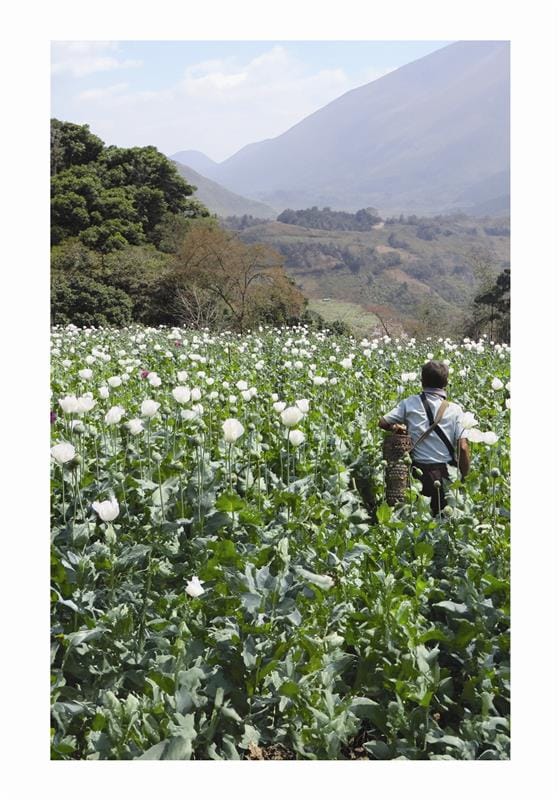
The 1950s to the 1980s laid the foundation with opium cultivation and circulation. Myanmar’s Shan state with figures like Khun Sa garnered infamy and created a proto state that was financed solely with heroin production and sale. Sa’s organisation was central in raising armies, implementing taxation, and providing services like healthcare and schools - all activities performed by the state. Sa managed to create a global drug empire that secured him wealth and infamy. His reign was one of the earliest examples of how sovereignty could be built using narcotics.
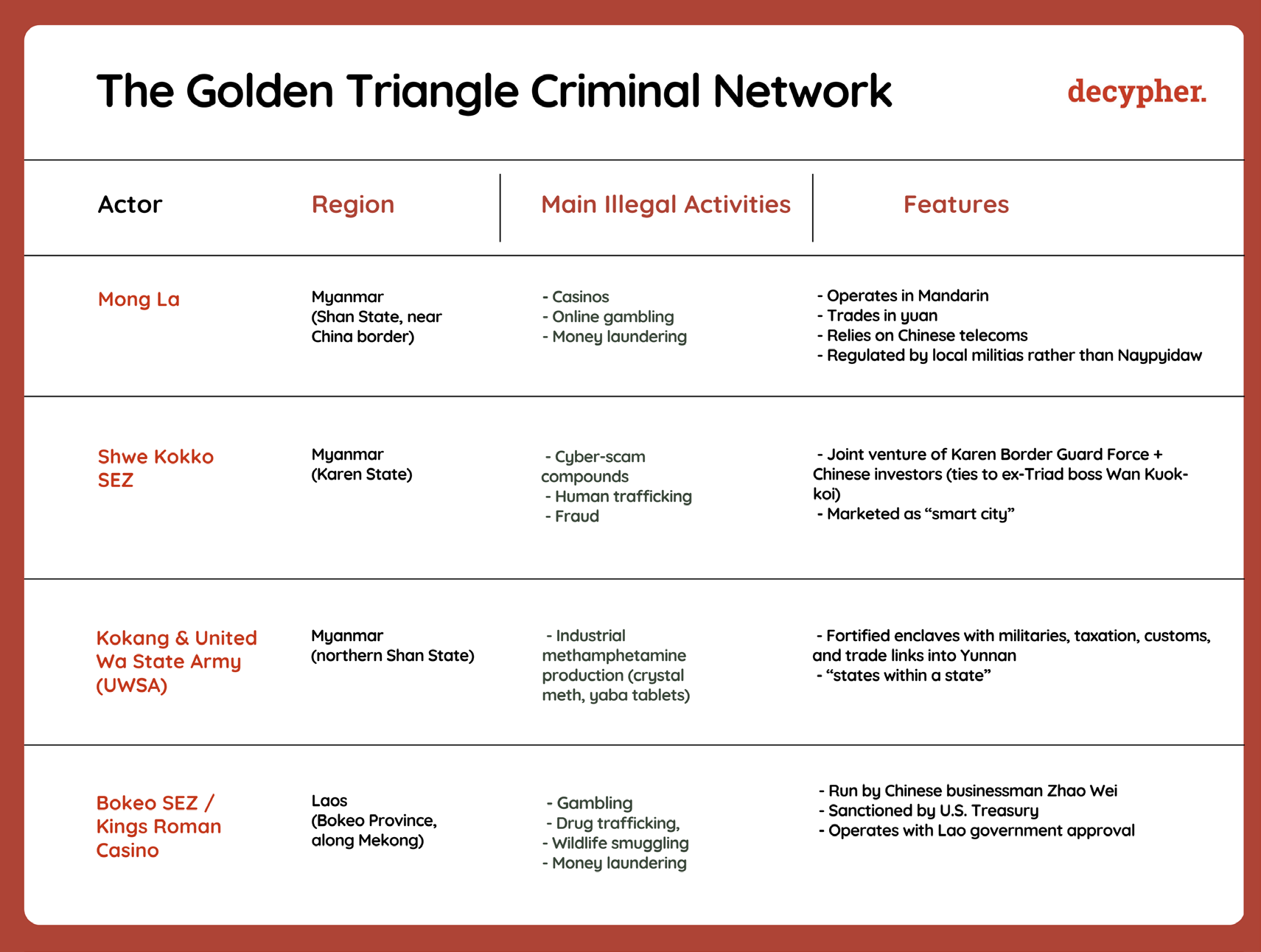
The early 2000s saw this trade adapt to the production of methamphetamine. This was facilitated by military bodies like the United WA State Army (USWA) of Myanmar that created an industrialised production hub of this drug in the Golden Triangle, creating laboratories and a global distribution network. The USWA was successful in setting up small state-like enclaves that included bureaucracies, customs, and major trade links into China’s Yunnan province. Methamphetamine was a far more scalable and profitable drug than opium, giving such militias grounds to consolidate their standing and wreaking havoc across Asia.
The development of technology and the digital age of present times led to a significant change in operations in the Golden Triangle. Since 2015, small townships in these areas have been able to transform themselves into illicit economies that tap into digital developments - casinos, cyber-scam operations like pig butchering, human trafficking, and money laundering through cryptocurrency have become operational. These activities are not covert and happen in broad daylight. Towns such as Mong La and Bokeo are examples of such “smart cities” and “special economic zones” that use unethical labour practices, duping people on grounds of employment and creating a facade of modernity and freedom to disguise one of the largest rings of illegal transnational narcotics trade and human trafficking. Recent reports from the Golden Triangle Special Economic Zone (GTSEZ) that was established in 2007 suggest that wildlife trafficking including cultivation of tiger farms are carried out here as well.
One simply needs to stroll along the banks of the Mekong River, near the Bokeo province of Laos to see an open environment of crime and debauchery. With gambling becoming illegal in Macau, Laos has emerged as the foremost place for casinos and gambling. The shops in the GTSEZ openly sell Tiger Wine - a Chinese delicacy made from the bones of a tiger, ivory bracelets derived from tusks of elephants and other novelty items all indicating illegal wildlife activity. What is of relevance here is that China’s presence is prominent in these areas - the Yuan is the currency of exchange, the sign boards are in Chinese, and most restaurants serve Chinese food including most of the patrons being Chinese business men who can easily access these cities with cars or flights. Most of the owners of these casinos and other ventures are ex-Triad members. Thus, the re-engineering of the criminal sovereignties of the Golden Triangle has not happened without Chinese permission.
China’s Stakes in the Matter: Domestic vs Strategic Goals
China remains ambivalent to the presence of these criminal networks. While Beijing does acknowledge the danger of having these enclaves so close to their borders, especially given the easy penetration of methamphetamine into Yunnan, which has caused severe harm to Chinese communities and cybercrime operations using Chinese telecommunication networks to defraud its citizens. It also allows these activities to flourish with steady investment, surveillance and a controlled engagement with the fragile states that neighbour it to leverage Chinese influence. This has resulted in a structural dilemma for China that does not allow it to completely eradicate these entities without tensions on its borders. However, while these activities continue to take place, China cannot deny its enablement in them as well.
China has adopted a strategy of selectiveness that allows it to display outrage when domestically needed and turning a blind eye, when matters of regional influence come into play. This is evidenced by its crackdown on the activities of the area following the 2011 Mekong massacre, where 13 Chinese nationals were killed and China deployed joint patrols with Laos, Myanmar and Thailand to manage affairs. Crackdowns on scam centres in Myanmar and Thailand prove that Beijing is willing to get its hand dirty when need be.
This ambivalence exposes a larger structural paradox that faces China today. Its stately duties do not allow it to let its citizenry get victimised but as a regional power it cannot break such enclaves, which have become integral to its influence in Southeast Asia. Destabilising fragile states and border areas, while creating chaos among the militia outfits in this region are outcomes that China does not want.
The client regime it has established in both Laos and Myanmar cannot be imagined without engaging with these criminal sovereignties. Thus, China borders between co-option and policing. While these zones are harmful, they also serve larger Chinese interests and cannot be eradicated as easily.
The Mekong River and its Strategic Implications for China
The Mekong River binds the geopolitical narrative of the Golden Triangle together. Its vast presence across Tibet from Yunnan into Southeast Asia’s mainland is central to illicit and legal economic activities in the region. It is used for transportation purposes, agriculture and fisheries while simultaneously being used to smuggle narcotics, people, timber and wildlife. Given its geographical vitality, it is the perfect route for smuggling and discreet movement of goods. For China, the river makes Yunnan especially vulnerable to contraband.
The Lancang-Mekong Cooperation (LMC) and the regular patrolling units are China’s way of ensuring things remain under control. The LMC framework creates an extensive programme of dam building that allows China to wield a form of hydrological power over downstream states. The capacity to withhold and release water offers Beijing a profound form of political control in the region that is heavily dependent on the river for its livelihood.
The river is deeply entangled in the snares of the criminal sovereignties that operate in the region, whether it be casino towns like Mong La or Bokeo. The river and its tributaries are used as transportation and a marketplace for trade. The Mekong has emerged as a securitised frontier as seen above since 2011.
What is notable is that Southeast Asian countries have not taken to China as easily. Laos has welcomed Chinese investment partnerships, but it also engages with the United States - China’s largest enemy globally. They have signed the Mekong-U.S. partnership, which allows some autonomy from Chinese influence. A similar stance has been adopted by Myanmar, while dependent on Chinese investment, it maintains limited engagement with Western countries. The Mekong in all has emerged as a securitised arena where regional and global interests are playing out.
Thus, the Golden Triangle manifests the great power rivalry between the United States and China where competing narratives are promoted. While the Chinese present themselves as a guarantor of economic growth with an emphasis on infrastructure development and shared development, the United States seeks to curtail the criminal excesses of the region by promoting the rule of law, good governance initiatives and transnational crime reduction - more of which will be discussed later. This makes the Golden Triangle not simply an area of crime and drug production but a geopolitical arcade where great power compete, Hydro politics plays out and small fragile states partake in hedging to maintain some degree of autonomy.
Examining U.S. Interests in the Region
Distance does not keep the U.S. at bay when it comes to matters in the Golden Triangle. The nature of the transnational crimes being committed here mostly target rich white American males, especially the cyberscams. The U.S. has imposed sanctions on figures like Zhao Wei and multiple Myamarie military leaders - all implicated in crimes like trafficking, smuggling, pig butchering and running scam centres.
The United States has also been insistent on maintaining rule of law through governance reforms, anti-trafficking measures and capacity-building programmes as implemented under the Mekong-U.S. Partnership. While this highlights a very normative engagement of the U.S. based on promotion of human rights and creating legitimacy for these states, there is a geopolitical motive behind its engagement as well.
Firstly, the United States has been posturing itself as a counter-balancer to China’s selective enforcement policy in the region. While these criminal sovereignties are co-opted by the Chinese to advance its strategic needs, the United States projects itself as a global player that plays by the book. It champions itself as protector of the region, whether these countries want this protection or not is a debate for another time.
Secondly, it presents issues along the lines of human rights violations. Whether it be the environmental decay of the Mekong with all the dams China is building, or protecting its citizens from losing billions of dollars in cyber scams annually.
However, the endurance of these criminal sovereignties is commendable. While they use hedging as a tactic to balance the interests of both China and the United States, their tolerance by local governments makes these entities difficult to contain. The result is a stalemate-like situation where these sovereignties endure in the region.
Beyond Security and Geopolitics: The Human Cost of Crime
While the Golden Triangle is a highly securitised region, the hybrid system that has emerged in the area has wider implications for society. Firstly, the criminal sovereignties that have emerged here warrant a reconsideration of what sovereignty is. The traditional, unitary and territorial view of sovereignty as encoded in the states has been thrown into flux in the region. The sovereignty seen in the Golden Triangle is multiple, hybridised and very often commodified. Order in these societies are negotiated with militias, business entities and the state who co-govern. Authority is not centralised here and dispersed across multiple actors that defies conventional practices.
Secondly, these criminal sovereignties are highly reflexive. They have evolved with the technological development of the world. They use modern currencies like crypto to facilitate a vast network of financial transactions that circumvent most anti-money laundering measures. They have become adept in the use of artificial intelligence, deepfakes and creating fake identities to create a vast network of duping. Technology has been wielded by these sovereignties with resilience and effectiveness.
Thirdly, these sovereignties are built on human suffering. Whether it be the cyber scam centres that run mostly by trafficked workers from parts of South America, Africa and Asia who are duped on false pretence of work and inducted into a system characterised by mental torture, physical abuse and psychological damage. Myanmar, Laos, Indonesia all grapple with the effects of easily available meth and Yaba tablets, bringing with it all the trauma associated with addiction at the personal, familial and societal level.
Conclusion
The paradox of criminal sovereignties and their functioning is best exemplified by the Golden Triangle. They are detrimental to states, while simultaneously ensuring their survival. For the Chinese, the Golden Triangle represents an often-obvious example of its transactional political engagements with the world order. On the one hand, it seeks to create a safer world with deeper regional engagements as laid down in their Global Security Initiative (GSI), on the other it tolerates some of the most heinous criminal activities that take place an hour away from its borders. The geopolitical dimension, where the United States feels compelled to enter the fray due to the cost of these criminal operations on its citizenry has forced smaller Southeast Asian states to become part of the great power rivalry of the 21st century.