

- Español
- Hindi
- Marathi
- Kannada
- 中文 (简体)
- Français
A Conversation with Daniel Treisman
Amogh Rai
A lot of people have read this book. Over the past year it has been a topic of constant conversation, both serious and superficial, across the world. But there are many who have not read it. I hate to do this to the author, since it is the result of multiple research papers, but for those who have not: in five to seven minutes, what is the CliffsNotes version, the long summary?
Daniel Treisman
The book grew out of conversations I had with my co-author about how the regime in Russia was evolving in the 2000s and 2010s. We saw a kind of authoritarianism emerging that looked different from the stereotypical regimes of the twentieth century.
Back then, dictators tended to be very violent. They imprisoned large numbers of opponents, often killed dissidents, and relied on fear as their main strategy of control. But in the early Putin years – not the later ones – we saw something else. His system was clearly not democratic, but it was different from Stalin, Mao, Pinochet, the Argentine junta, or African rulers like Mobutu. It seemed like a new kind of dictatorship, and as we looked around the world, we found parallels. Hugo Chávez in Venezuela, Erdoğan in Turkey, Viktor Orbán in Hungary – all were maintaining control while keeping the appearance of democratic institutions.
In practice, they stripped democracy of almost everything. We began to ask how to define and measure this model. A few elements stood out. Instead of spreading fear, these leaders aimed to secure genuine public support, but they did so by manipulating information. They censored covertly and controlled media. Often they left a small independent outlet alive, just to preserve the appearance of democracy, but it had little reach.
They avoided mass imprisonment, since that would make their authoritarianism too obvious. Elections were held, but quietly manipulated – rigged if necessary, or simply smoothed to guarantee results. They avoided heavy ideology. Unlike the twentieth century’s official dogmas, their main appeal was usually nationalism, presented in a way that still looked compatible with democracy.
The central goal was to maintain high approval ratings. Their rule was justified as popular, but this popularity was artificial: real opponents were excluded from the media, barred from ballots, or neutralised by regulations.
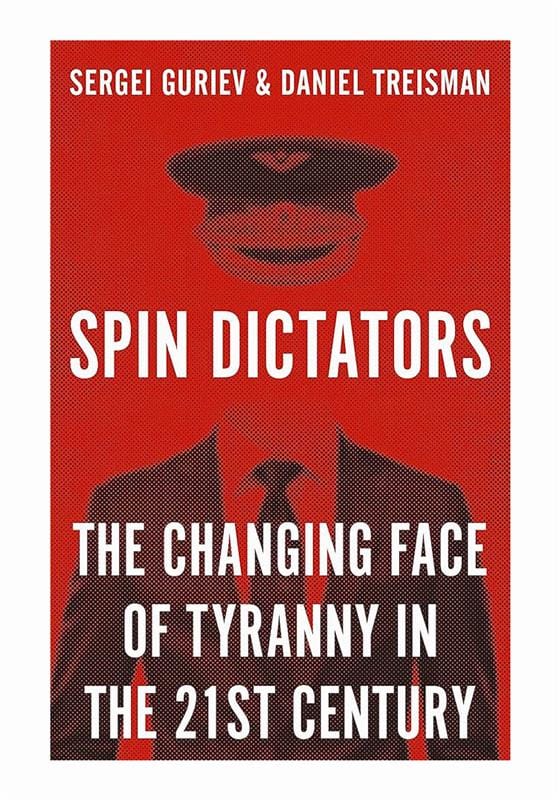
We saw this model in many places. We labelled it a “spin dictatorship” or “informational autocracy,” and contrasted it with the “fear dictatorships” of the twentieth century. Collecting data, we found that spin dictatorships had grown dramatically. Between 1970 and 2010, they rose from about 10 percent of non-democratic regimes to more than 50 percent. That is the book’s basic point.
We then asked why this shift had happened. And we also stressed that spin dictatorships do not always remain so. Some evolve. Putin is a case in point: he began as a spin dictator, converting democratic institutions into a pseudo-democracy. But over time, especially with the war in Ukraine, he reverted towards open repression. Russia today is again more like a classic fear dictatorship, openly intimidating any opposition.
Daniel Treisman
In Russia today, opposition has been forced out of the country or jailed on pretexts. The small independent media outlets that once existed have been shut down, so any free press now operates from abroad. The rhetoric has also shifted. Early on, the government tried to present itself as competent, professional, and caring. Now the emphasis is on external threats, the dangers facing Russia, the need for loyalty, and portraying critics as traitors.
We have seen similar changes elsewhere. In Venezuela, Maduro relies much more on overt violence and fear than Chávez did. Still, many regimes remain closer to the spin dictator model, and some new ones have appeared since we wrote the book. In Serbia, Aleksandar Vučić has created what looks like a spin dictatorship, although it is unclear whether it will prove stable. It may still be replaced through democratic means.
So, to summarise, we argue that there has been a trend towards manipulative, deceptive, less violent regimes that pretend to be democratic, replacing the earlier violent, ideological, and often totalitarian dictatorships of the twentieth century.
Amogh Rai
Thank you. For everyone listening, the book goes much deeper, with anecdotes, data, and visuals, so please do read it. Professor Treisman, one case study that immediately stands out is Lee Kuan Yew. You use him as a starting point and then show how others have followed his model. But should we call the Lee Kuan Yew system a spin dictatorship, or is it a quasi-democracy?
Daniel Treisman
I am not sure what quasi-democracy means. At some point, if a system does not allow genuine turnover in government, it cannot be called a democracy. I do consider Singapore under Lee Kuan Yew to be the original modern example of informational autocracy, and the most successful one. Many authoritarian leaders have tried to imitate it.
Amogh Rai
But not quite perfected it?
Daniel Treisman
Exactly. The People’s Action Party (PAP) has won election after election, usually with around 90 percent of parliamentary seats. Its share of the vote has been lower, but the electoral system translates this into overwhelming dominance.
There are mechanisms that prevent real opposition from posing a threat. The media is tightly controlled through boards aligned with the government. On the surface, citizens can speak freely and run for office. In practice, however, critics face serious consequences. Defamation suits are used with devastating effect, imposing extreme financial penalties. Some opponents have been bankrupted and therefore barred from standing in elections.
So, a whole set of techniques pioneered in Singapore have later been adopted by other authoritarian rulers. The reason I would not call it a democracy is that it is very hard to imagine any party seriously challenging PAP control at the ballot box, at least up to now.
Amogh Rai
That is exactly the answer I was looking for. When I researched outside the book, I noticed that Lee Kuan Yew constantly referred to democracy, redefining it to fit his context. Putin, Orban, and others have used similar strategies, though without reaching the same level of refinement.
Looking at the examples in your book – from Peru to Berlusconi’s Italy – what unites them is a reinterpretation of history. And you and your co-author argue that with more university graduates, spin dictators face a crossroads: either move towards democracy or revert to the old model of fear. For many, whether in Singapore or Russia beyond Moscow, this tension remains unresolved.
Amogh Rai
This long-winded theory of history seems to give spin dictators a sense of their place in the world. How do you see their interpretation of democracy and history in light of your research?
Daniel Treisman
That is an interesting question. Many authoritarian leaders justify themselves through distorted versions of history. Democratic politicians also idealise the past, especially when their party was in power, but authoritarian leaders take this much further. They can silence critics who challenge their version of events.
Is this different from the way fear dictators of the twentieth century used history? I think so. Under Stalin, Khrushchev, or Hitler, history was tied to an official ideology. Marxism-Leninism in the Soviet Union, or Mein Kampf in Nazi Germany, shaped how history was presented. It was not simply a flattering narrative but part of a broader doctrine imposed on citizens.
Spin dictators, at least in their early phases, tend to offer histories not far from what nationalist democratic politicians might say. Putin in his early years talked about Russia rejoining Europe and taking its place among modern powers. Later, especially since the war in Ukraine, he has become obsessed with minute historical details, going back to the Middle Ages, which marks a sharp turn back towards an older model of rule.
Other spin dictators use history too. Erdogan appeals to Turkey’s Ottoman past. In Singapore, Lee Kuan Yew and his successors emphasised Singapore’s unique development path, external threats, and cultural arguments about Asian values being distinct from Western ones. This became a justification for their particular version of democracy, though I am not sure it represents a radically different conception of history compared to mainstream accounts.
Amogh Rai
Let me give an example. I watched Tucker Carlson’s interview with Putin. It was a nightmarish display of distorted history.
Most of the facts were wrong, yet because it was presented as a great revelation, it was hard to ignore. Viktor Orban did something similar in his interview with Carlson in Budapest.
Hungary is an interesting case. As you note in the book, spin dictators often join multilateral organisations. They gain access to democratic institutions and tools, which they then manipulate. Hungary is a member of the EU, but also of the Organization of Turkic States, even though the theory that Hungarians descended from Turks has long been discredited.
Yet Orban embraces this narrative. He funds think tanks, promotes reports, and pushes this view until it becomes part of public discourse. This is striking because we live in an age of spin, where many will read a flashy report rather than a 300-page scholarly book. Leaders like Orban exploit that by rewriting history in ways that support their political strategies.
Amogh Rai
Could you give me a short version? I’m more familiar with democracies, so that was my intent. How do you challenge this?
Daniel Treisman
Spin dictators certainly use history. They distort rather than completely invent facts, and they present them in a somewhat deceptive way. They are also less concerned with consistency.
Take Putin’s early rhetoric. It was a kaleidoscope of historical references, often contradictory, designed to appeal to different audiences. He drew on Soviet nostalgia, pre-Soviet imperial grandeur, and modern post-Soviet narratives. This artistic reassembly of fragments created a mosaic that resonated with people from very different backgrounds. That is quite characteristic of spin dictators, and distinct from fear dictators, who, when tied to an ideology, tried to keep it more internally consistent and grounded in key texts.
Amogh Rai
Yes, and to add to that—this comes from the book—you describe the term “tsar” being applied to Putin. It reimagines a glorious era, casting Russia as a great power once more. Today, Russia is a fraction of the United States’ economy, but it still sustains an empire of influence with Putin at its centre.
Similarly, in Turkey, Erdogan is often referred to as “the publisher” in Turkic newspapers, which harks back to an older imperial identity. These uses of language deliberately recall past glory. But here’s my question: with ideology. Would you say we are now past the age of ideology in the sense of violent dictatorships, and that spin dictators instead use religion as a substitute?
If you look at Putin and the Russian Orthodox Church, Erdogan and political Islam, or Mohammed bin Salman, you can see different versions of religion being mobilised as tools of control. So, is religion now an important feature of spin dictatorships?
Daniel Treisman
I would not say it is characteristic. Spin dictatorships vary enormously. Politically, some are on the right—early Putin, or Singapore under Lee Kuan Yew—others on the left, such as Hugo Chávez. It is the same with religion. Some leaders, like those you mentioned, draw on it heavily. Others—Fujimori in Peru, or Singapore’s leaders—did not emphasise religion at all.
Religion is used opportunistically, depending on the context. If a ruler governs a religiously homogeneous society, religion is a more powerful tool. In a multi-religious society, it is harder to exploit without alienating groups. Nazarbayev in Kazakhstan, for example, used different rhetoric when addressing Russian-speaking citizens compared to Muslim Kazakhs. This kind of inconsistency is very typical.
As for history, dictators in general emphasise the past more than democratic leaders, who usually focus on the present and future. Spin dictators mimic democrats rhetorically, so some do talk about the future as well. But the reliance on selective versions of the past remains common.
Amogh Rai
That’s helpful. One of the interesting features of your book is a graph showing the emergence of spin dictatorships around the 1980s, coinciding with the rise of the neoliberal consensus.
Amogh Rai
Speaking now as an economist, this period coincides with the Washington Consensus. We saw second and third generation reforms in different regions, and at the same time, spin dictatorships seemed to mature. Before that, there were only a few. Did the neoliberal consensus make resource control easier and allow spin dictatorships to boom? Take Russia, for instance.
Yeltsin’s tragedy was selling nickel and petroleum companies for almost nothing. Then came Putin, who famously told the oligarchs to leave politics if they wanted to keep their companies. Figures like Berezovsky were sidelined. Did neoliberal reforms help spin dictatorships consolidate power?
Daniel Treisman
We see the rise of spin dictatorships as linked to economic modernisation. The relationship between the Washington Consensus and the rapid economic growth of the late 20th century can be debated, but what matters is the broader global change. Many countries experienced dramatic increases in wealth, though also rising inequality.
What was most relevant to spin dictatorships? First, the growth of the middle class. Second, the shift from industry to a knowledge economy. Heavy-handed repression was no longer sustainable, as innovation required the free flow of ideas. Third, media diversification meant information could not be monopolised as easily.
Added to this was the spread of democratic ideals. Middle classes wanted representation, at least to some degree. Globalisation further complicated outright repression. Dictators had incentives to be more inventive, to mimic democracy, and to exploit its advantages. This gave them domestic legitimacy and international benefits, such as foreign investment and better relations with Western governments.
So economic development, globalisation, and the paradigm shifts of the 1980s and 1990s laid the groundwork for a new model of dictatorship. It was less about neoliberal ideas themselves and more about vast global economic and social changes that made the spin dictatorship viable.
Amogh Rai
One striking characterisation in your book is of spin dictators in sharp suits at Davos and the World Economic Forum. What troubles me is the role played by global consultancies. Many worked closely with Russia. When I looked back at publications from the big four or McKinsey, they painted a glowing picture of Russia’s transformation.
Between 2001 and 2006, Putin could do no wrong in their eyes. He was hailed as a transformative leader. Yet on the ground, alcoholism was rampant, and young male mortality was shockingly high. Control over people’s lives was slipping, but international consultancies and rating agencies created a halo around Putin. How responsible are such firms for giving wannabe dictators a platform?
Daniel Treisman
The answer is complex. On Russia, the sharp rise in alcoholism and mortality actually occurred in the 1990s under Yeltsin, not under Putin. These problems did persist into the early 2000s, but from around 2002 they declined sharply. Social reforms and changes under Putin helped reduce mortality and alcoholism. As the middle class grew, people substituted away from dangerous hard liquor, which contributed to the improvement.
Daniel Treisman
Binge drinking shifted towards beer and wine in the early 2000s, and health outcomes stabilised compared to the crisis of the 1990s. That was one part of the picture.
Why did consultancies and international opinion give Putin a break in the early 2000s? The economy was booming. The stock market surged, oil prices rose, and billionaires multiplied during Putin’s early years. To many, Russia looked as if it were on a positive path. It is understandable that consultancies focused on those numbers.
I too may have underestimated the dangers. I was aware of them, but not their future impact. Still, Putin’s path was not predetermined. In 2000–01, he appeared open to closer cooperation with the West. Based on his private conversations with people I have spoken to, he genuinely considered it. The Putin of 2000 looked quite different from the Putin of 2008, let alone today.
The security services became increasingly dominant, but at first their influence was less visible. We still do not fully know how or why Putin’s regime hardened. In the early years, it could have developed differently. It might have remained a spin dictatorship rather than reverting to fear. It might even have evolved into something more competitive or democratic, particularly if Putin had stepped down.
There seemed a moment in 2008, when he handed power to Dmitry Medvedev, that he could have felt safe enough to retreat. He chose otherwise. That choice was not inevitable, though in retrospect it seems so. Consultancies were not completely wrong; they simply overemphasised positive economic numbers, which shaped their optimistic assessments.
Amogh Rai
I agree with your points. You are the Russia expert, and I accept your timeline of events. My own focus is China, which is fascinating because it straddles both categories: spin dictatorship and fear dictatorship. It manages to be in both camps simultaneously.
It was not always so. In the early 1990s, many assumed China was on a path to democracy. In 1996 or 1997, Bill Gates predicted that new technology would undermine the Communist Party’s control. Two and a half decades later, that has proven entirely wrong.
To borrow from historian Stephen Kotkin, when researchers entered the Soviet archives, they discovered the USSR was indeed a communist country. Similarly, when consultancies spoke about China, they often forgot it was still a communist regime. Today, nobody seriously considers China a democratic hope.
But let us take Vietnam. Where would you place Vietnam on your spectrum of spin versus fear, especially now that the president has just resigned under mysterious circumstances?
Daniel Treisman
There is no guarantee that the world will remain as interconnected as it is today, nor that economic development will continue. Growth has persisted for a long time, despite recessions and downturns, but nothing ensures that trend will hold.
Still, if economic and social modernisation continue, it becomes harder to control a country through mass repression. Old authoritarian tools that worked in agricultural or early industrial societies are less effective in a knowledge economy. The pressure, therefore, is towards progress.
But the caveats matter. Modernisation and globalisation could plateau. Many argue we are already in a “democratic recession”, with pressures against democracy growing stronger and the number of democracies slightly declining. Trade and globalisation also appear to be stalling. So yes, mine is a very conditional optimism.
Amogh Rai
Thank you. I will take that optimism—it is much needed. This has been eye-opening on many levels. I hope everyone here picks up the book and engages with it further. And I hope you enjoyed this conversation as much as we did.
Daniel Treisman
Thank you very much. It was a great discussion, and I appreciate your interest.